
5 Best Automatic Door Types for Hospital Wards in Singapore
5 best automatic door types for hospital wards in Singapore — sliding, telescopic, hermetic, swing, and accessible. Covers BCA compliance, MOH ward design, and clinical hygiene requirements.
Summary
- Selecting the right automatic door for a Singapore hospital ward requires balancing specific clinical hygiene needs, ward traffic patterns, and strict local BCA and MOH compliance.
- Different hospital zones demand specialized solutions, such as airtight hermetic doors for sterile operating theatres and high-cycle sliding doors for busy main corridors.
- Specifying the correct door type for each clinical zone is crucial to mitigate infection risks, ensure patient safety, and meet mandatory BCA accessibility standards.
- As a single-source provider, Frameshft offers engineering consultation to design, supply, and install certified automatic door systems tailored to the unique requirements of each hospital ward.
Choosing the right automatic door for a hospital ward in Singapore is far more complex than selecting a standard commercial entrance. For Facility Managers (FMs) in Singapore's healthcare sector, every door specification sits at the intersection of three critical demands: clinical hygiene requirements, ward-specific traffic patterns, and strict local compliance obligations under the Building and Construction Authority (BCA) Accessibility Code and Ministry of Health (MOH) ward design expectations.
The stakes are real. A generic commercial door installed in an ICU or Operating Theatre isn't just a specification shortcut — it's a patient safety risk. As clinical staff know well, "infection control but still being able to see the room" is not a contradiction to manage around; it's a design requirement to engineer for. From the high-traffic main corridor to the sterile field of an operating theatre, each zone demands a different entrance solution.
This guide breaks down the 5 best automatic door types for hospital wards in Singapore, covering the specific ward zones each suits, their key clinical benefits, and what to look for when specifying for local compliance.
1. Automatic Sliding Door — The Workhorse of Main Corridors
Best for: Main entrances, high-traffic corridors, general circulation zones, and ICU perimeter access.
In any Singapore hospital, the main corridor is the circulatory system of the building — stretchers, wheelchairs, medication trolleys, and clinical staff move through it continuously. An automatic sliding door is the default choice here, and for good reason.
Sliding doors achieve wide clear openings without consuming swing arc space. As frontline clinical staff rightly point out, "sliding doors tend to be wider and take up less space when open" — a seemingly small detail that matters enormously when you're manoeuvring a patient bed through a corridor at speed. Touch-free activation removes a key vector for surface-based cross-contamination, and glass panel integration supports "constant visual monitoring" — critical in ICU perimeter zones where staff need sightlines without physically entering a room.
What to look for in specifications:
- High-speed operation (to prevent bottleneck formation during peak traffic hours)
- Robust cyclic endurance (hospital corridors run 24/7, 365 days a year)
- DIN18650-1:2010 and EN16005 safety compliance
- Self-diagnostics for proactive fault detection
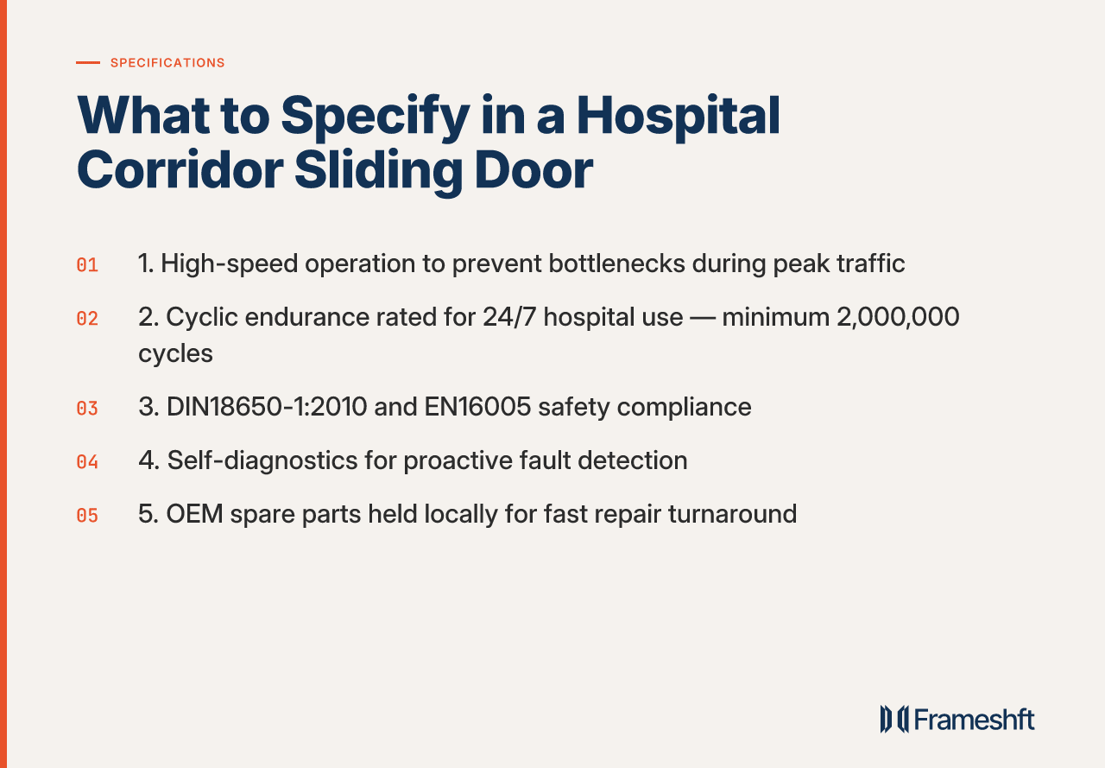
Frameshft's Automatic Sliding Door is purpose-built for demanding institutional environments, with systems installed at Changi General Hospital. Powered by a German Dunkenmotoren drive unit, it supports door weights from 200–360kg and operates at up to 1,400mm/sec — fast enough to avoid corridor bottlenecks without compromising safety. Cyclic endurance is factory-tested to 2,000,000 cycles, and the self-learning processor with auto error detection means your maintenance team gets ahead of faults rather than reacting to them. Critically, Frameshft holds OEM spare parts in Singapore — no waiting on international shipments when a critical ward entrance needs urgent repair.
2. Automatic Telescopic Sliding Door — Maximum Opening in Minimum Header Space
Best for: Narrow corridor entrances, ward access points in older hospital wings, and areas requiring wide clearance within constrained architectural footprints.
Not every hospital ward was designed for today's clinical equipment. Retrofit scenarios — particularly in older hospital blocks or A&A projects — frequently present a maddening constraint: you need a wide clear opening for beds and equipment, but the overhead header space simply won't accommodate a standard sliding door's track geometry.
This is precisely where the telescopic sliding door earns its place. Its multi-panel design folds multiple leaves into a stacked configuration, achieving a substantially wider opening than a conventional two-panel slider within the same overhead allowance. For Singapore hospital FMs managing upgrades to existing facilities, this solves an otherwise expensive structural problem without requiring full frame reconstruction.
"Visibility, space is critical for equipment and personnel" — telescopic sliding doors directly address this by maximising the usable opening width in zones where "double sliders can hinge open for massive access" is not just a preference but an operational necessity.

Frameshft's Automatic Telescopic Sliding Door is engineered specifically for this constraint — suitable for hospitals, and particularly relevant for Singapore's mix of newer purpose-built facilities and older ward blocks undergoing modernisation.
3. Automatic Swing Door — Versatile Access for Internal Ward Areas
Best for: Internal ward rooms, consultation rooms, staff-only service corridors, and accessibility-designated entrances.
Not every hospital entrance needs the large clear span of a sliding system. Internal ward rooms, consultation suites, and staff access points often sit within standard door frames — and this is where the automatic swing door delivers the most practical and cost-effective upgrade.
The primary clinical value of an automatic swing door is hands-free access. A nurse carrying IV supplies, a physiotherapist with mobility aids, or a porter transporting linen doesn't need to touch the door at any point. Touchless activation removes a contact surface from the infection pathway — a small but measurable contribution to overall hygiene protocols.
Swing doors also carry significant fire safety integration potential. In Singapore healthcare facilities, doors on evacuation routes or compartment boundaries are commonly required to be held open under normal conditions and automatically released on fire alarm activation — a function automatic swing door systems manage natively.
Singapore compliance note: Under the BCA Code on Accessibility 2025, accessible routes within hospitals must meet defined clear opening widths, activation reach ranges, and safe operating forces. Specifying a non-compliant door and retrofitting accessibility features post-installation is both costly and unreliable.
Frameshft's Automatic Swing Door supports both single and double-leaf configurations with touchless activation, and is engineered for full BCA accessibility compliance from the specification phase — not bolted on after a BCA audit finding. This is the distinction that matters to Singapore FMs managing institutional procurement with regulatory accountability.
Compliance Is Not an Add-On Frameshft delivers automatic swing doors engineered for full BCA accessibility compliance from day one. Avoid costly audit failures and piecemeal retrofits. [Request Pricing]
4. Automatic Hermetic Door — The Guardian of Sterile Environments
Best for: Operating Theatres (OTs), Intensive Care Units (ICUs), Isolation Wards, Negative Pressure Rooms, and Radiology suites.
If there is one door type where specification errors have direct clinical consequences, it is the hermetic door. In Operating Theatres and ICUs, the door is not merely a physical barrier — it is an active component of the infection control system.
Hermetic doors create a certified airtight seal when closed, which is essential for environments that operate under positive or negative air pressure differentials. Singapore's National Centre for Infectious Diseases (NCID) describes the mechanism clearly: in negative pressure isolation rooms, when the door opens, air is drawn inward from the anteroom into the patient's room — preventing infectious agents from escaping into the corridor. This only functions as designed if the door maintains a true pressure seal when closed. A standard commercial door, regardless of how well it fits its frame, cannot guarantee this.
The acoustic insulation benefit is secondary but significant — a hermetic door reduces sound transmission, contributing to the quieter recovery environment that post-operative and ICU patients require.
MOH alignment: MOH ward design expectations for critical care areas and surgical suites implicitly require entrance systems capable of supporting controlled-environment integrity. Hermetic door certification to air permeability and air tightness standards is the engineering proof that a door can fulfil this function.
Key specifications to require:
- Certification to BS EN1026:2000 (Air Permeability) and BS EN12207:2016 (Air Tightness)
- Failsafe motor locking (the door returns to sealed position on power failure)
- Capacity for heavy lead-lined leaves (relevant for radiology applications)
- Sound insulation rating (STC35 or above)
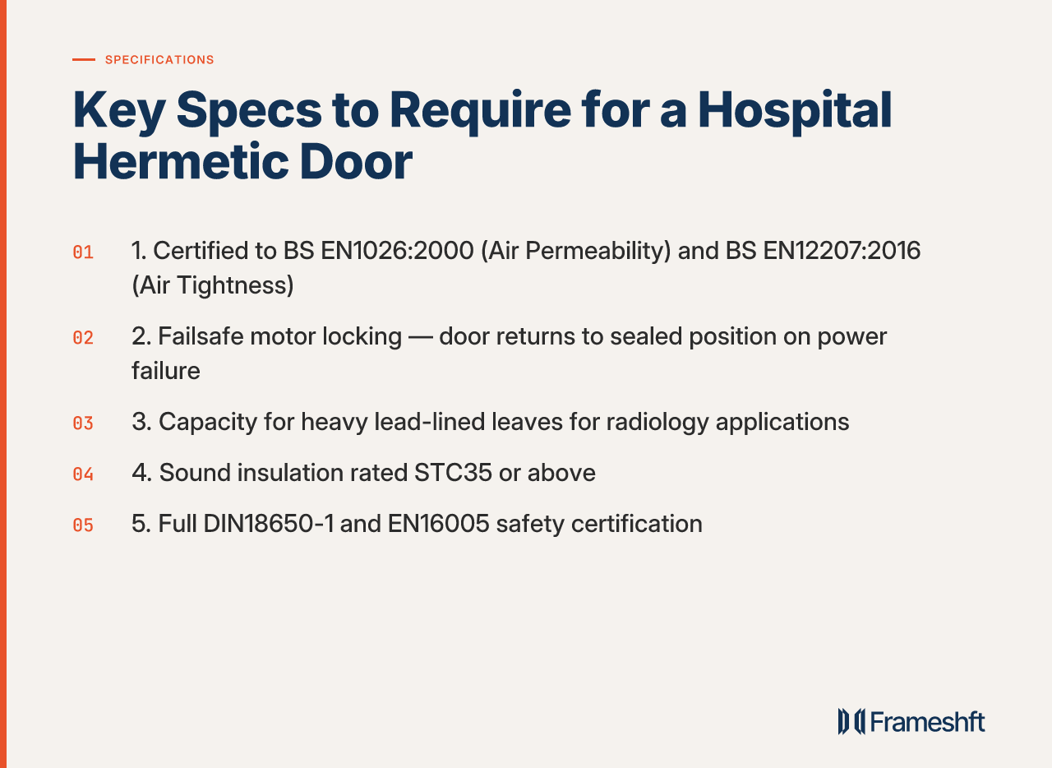
Frameshft's Automatic Hermetic Door meets this full specification stack — certified to BS EN1026:2000, BS EN12207:2016, DIN18650-1, and EN16005, with a 40V 100W German Dunkenmotoren motor with failsafe locking and support for door leaves up to 1,000kg (covering lead-lined radiology configurations). Sound insulation is rated at STC35. Frameshft is one of very few Singapore contractors carrying this complete certification set for hermetic doors, with installations at KK Women's and Children's Hospital (KKH) as proof of deployment in live clinical environments.

5. Automatic Handicap Toilet Door System — Ensuring Dignity and Mandatory Compliance
Best for: Ward-level and public restrooms, patient rooms, and any entrance on a designated accessible route.
Accessibility in Singapore hospitals is not a design preference — it is a legal obligation under the BCA Code on Accessibility. For hospital FMs, this means every restroom on an accessible route, every patient room entrance, and every public-facing threshold within the facility must meet defined criteria for clear opening width, activation button positioning, door operating force, and closing speed.
Beyond compliance, there is a direct patient care argument. A patient recovering from surgery, an elderly visitor, or a wheelchair user navigating a ward should not need to ask a nurse to open a restroom door. Hands-free, automated accessible entrances reduce the dependency burden on nursing staff — a measurable operational benefit in Singapore's healthcare staffing environment.
The risk for FMs who specify a standard commercial swing door and retrofit accessibility features later is well-documented: activation buttons at non-compliant heights, door forces that exceed safe limits for mobility-impaired users, or clear widths that fall just short of BCA thresholds — each one a potential BCA audit finding and a service disruption.
Frameshft's Handicap Toilet System approaches this as a complete, pre-engineered accessible entrance solution — not a standard door operator with an accessibility kit attached. BCA compliance is designed in from the first specification, covering all required parameters for wheelchair users, the elderly, and mobility-impaired individuals. For hospital FMs managing both new builds and A&A projects, this eliminates the compliance uncertainty that comes with piecemeal specification.
One Contractor, Full Accountability. Frameshft designs, supplies, installs, and maintains fully-compliant accessible entrance solutions under one roof. End vendor blame-shifting for good. [Speak to an Expert]
Choosing the Right Automatic Door for Your Hospital Ward in Singapore
Specifying the right automatic door for hospital ward Singapore applications is a decision that compounds over time. The wrong door in a high-traffic corridor creates maintenance burdens and flow bottlenecks. The wrong door on an OT or ICU creates clinical risk. The wrong accessible entrance creates regulatory exposure.
The five door types above map to distinct ward zones and clinical functions:
| Door Type | Primary Zone | Clinical Priority |
|---|---|---|
| Automatic Sliding Door | Main corridors, ICU perimeter | Traffic flow, visibility, hygiene |
| Telescopic Sliding Door | Constrained access points | Space optimisation, wide clearance |
| Automatic Swing Door | Internal wards, service areas | Hands-free access, BCA compliance |
| Hermetic Door | OT, ICU, isolation, radiology | Pressure integrity, sterility, acoustics |
| Automatic Handicap Toilet Door | Restrooms, accessible routes | Dignity, independence, BCA compliance |
Frameshft brings 14 years of Singapore healthcare installation experience, with a proven installed base at Changi General Hospital and KK Women's and Children's Hospital. As a single-source provider covering engineering consultation, system design, supply, installation, and long-term preventive maintenance, Frameshft eliminates the vendor fragmentation that typically follows multi-contractor hospital door projects — where accountability gaps emerge precisely at the most inconvenient moments.
All Frameshft systems are certified to the full relevant stack: TÜV, COC, CE (LVD Directive), DIN18650-1:2010, EN16005, BS EN1026:2000, and BS EN12207:2016.
Frequently Asked Questions (FAQ)
Why is choosing the right automatic door so critical for a hospital ward in Singapore?
Choosing the right automatic door is critical because each hospital ward has unique requirements for clinical hygiene, patient traffic, and safety, all of which are governed by strict local regulations like Singapore's BCA Accessibility Code and MOH guidelines. A generic commercial door cannot meet the specific demands of a sterile operating theatre, a high-traffic corridor, or an accessibility-compliant restroom. The correct door enhances infection control, ensures smooth patient and staff flow, and guarantees regulatory compliance, directly impacting patient safety and operational efficiency.
What is a hermetic door and why is it essential for operating theatres and ICUs?
A hermetic door is a specialized automatic door that creates an airtight seal when closed, making it essential for controlling air pressure, temperature, and humidity in sterile environments like operating theatres (OTs), ICUs, and isolation wards. This airtight seal is crucial for maintaining positive or negative air pressure differentials, which prevent the spread of airborne contaminants and are a core component of infection control protocols.
How do automatic doors improve infection control in a hospital?
Automatic doors improve infection control primarily by providing touch-free access, which eliminates a major surface for cross-contamination between staff, patients, and visitors. By removing the need to physically touch door handles, touchless activation via sensors significantly reduces the transmission of pathogens. Furthermore, specialized doors like hermetic systems actively support infection control by maintaining air pressure integrity in sterile zones.
What should a Facility Manager look for to ensure an automatic door is BCA compliant in Singapore?
To ensure BCA compliance, a Facility Manager should verify that the automatic door system meets all criteria in the latest BCA Code on Accessibility, including specified clear opening widths, correct placement of activation buttons, safe operating forces, and appropriate closing speeds. It is crucial to choose a system that is pre-engineered for compliance rather than retrofitting a standard door, ensuring the entire solution is designed as an integrated package for users with mobility impairments.
When should I choose a telescopic sliding door over a standard sliding door?
You should choose a telescopic sliding door when you need the widest possible clear opening but are limited by a narrow corridor or restricted overhead header space. A telescopic door uses multiple smaller panels that stack as they open, achieving a much larger opening within the same structural footprint. This makes it ideal for retrofitting older hospital wings where space is constrained but maximum access for beds is required.
What are the most important certifications for hospital automatic doors?
The most important certifications include safety standards like DIN18650-1 and EN16005, which ensure the door is safe for public use and mechanically robust. For specialized doors like hermetic systems, air permeability and tightness certifications such as BS EN1026:2000 and BS EN12207:2016 are critical. These certifications provide third-party verification that the door system can meet the stringent clinical and safety requirements of a hospital environment.
Ready to specify the right entrance system for your wards?
Every hospital facility has a unique combination of ward zones, traffic profiles, and compliance obligations. A one-size approach to door specification is how clinical facilities end up with the wrong system in the wrong location.
Book a no-obligation engineering consultation with Frameshft — and get an entrance solution designed for your facility's specific clinical and compliance requirements, not a generic commercial recommendation.
Tags
No tags
Published on June 01, 2026