
Automatic Door for Hospital Ward Singapore: Sliding vs. Swing vs. Hermetic
Automatic door for hospital ward Singapore: compare sliding, swing, and hermetic types across ICU, isolation rooms, and OT anterooms with BCA, EN16005, and DIN18650 compliance.
Summary
- Choosing an automatic door for a hospital ward is a critical engineering decision, not just a procurement task. The right door must match the specific clinical requirements of each zone, from infection control to air pressure integrity.
- The three main door types serve distinct purposes: automatic sliding doors are ideal for high-traffic corridors, swing doors suit fire-rated exits, and hermetic doors are essential for sterile environments like ICUs and operating theatres.
- For critical zones requiring air pressure control, such as isolation rooms, only a certified hermetic door can provide the necessary airtight seal to prevent cross-contamination.
- Frameshft provides certified automatic door systems and offers complimentary ward-by-ward engineering assessments to ensure your facility meets both clinical and compliance standards.
You've just spec'd out automatic doors for your hospital ward upgrade. The supplier quotes look reasonable, the lead times are acceptable, and the doors are all technically "automatic." Job done — right?
Not quite. This is the procurement trap that catches even experienced hospital facility managers: assuming any automatic door will perform acceptably in a clinical environment. In a hospital ward, doors aren't passive fixtures. They are active components of your infection control, patient safety, air pressure management, and operational continuity infrastructure. The wrong door in the wrong zone is a compliance liability and a daily clinical hazard — not a one-time mistake you fix at handover.
This guide cuts through the noise. We'll map the three main automatic door types — Sliding, Swing, and Hermetic — against specific ward zones, clinical performance criteria, and Singapore compliance standards (BCA, EN16005, DIN18650), so your procurement team can make decisions backed by engineering logic, not assumptions.
The High Stakes of Door Selection in a Hospital Environment
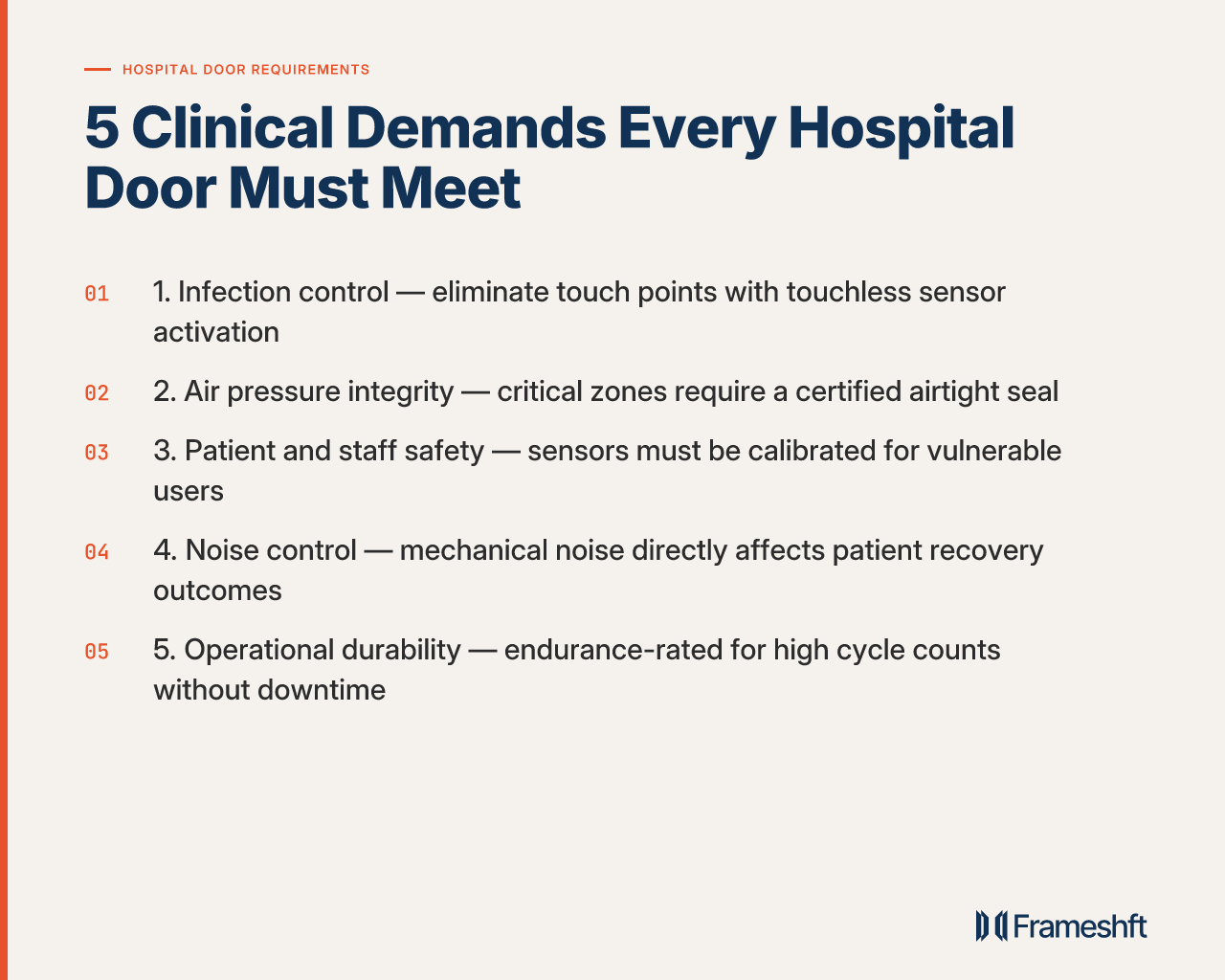
The clinical environment places demands on automatic doors that no commercial installation shares. Consider what a hospital ward door must handle simultaneously:
- Infection control: Every touch point is a potential transmission vector. Doors in healthcare settings must actively support sterile, safe environments — not merely allow passage.
- Air pressure integrity: Isolation rooms, ICUs, and operating theatres depend on controlled pressure differentials to contain or exclude airborne pathogens. A door that cannot hold a seal is a clinical failure, regardless of how cleanly it opens.
- Patient and staff safety: Vulnerable patients — in wheelchairs, on stretchers, post-sedation — interact with these doors under conditions where a mechanical failure or poor sensor calibration causes real harm. As discussed in facility management communities, standard motion sensors can create security vulnerabilities, and glass panel incidents in Singapore — where shards required two hours of surgical extraction from a child — underscore why material specification matters.
- Noise control: ICU and recovery ward environments are acutely noise-sensitive. Mechanical noise from a door system is not a minor inconvenience; it affects patient recovery outcomes.
- Operational durability: Hospital doors cycle far more frequently than commercial entrances. A system that isn't endurance-rated for high cycle counts will generate maintenance calls and downtime at the worst possible moments.
The decision framework, then, is not simply "which door looks right." It is: which door is engineered for this specific zone's clinical requirements?
The Three Contenders: A Detailed Clinical Comparison
1. Automatic Sliding Doors
The automatic sliding door is the workhorse of hospital corridor design — and for good reason. Its core strengths align well with the demands of high-traffic clinical spaces.
Frameshft's Automatic Sliding Door Operator, powered by a German Dunkenmotoren drive unit, supports door weights from 200–360kg, travel speeds up to 1,400mm/sec, and is cyclic endurance-tested to 2,000,000 cycles — a specification that matches the throughput reality of a busy ward. Where header space is constrained or opening spans are unusually wide, the Automatic Telescopic Sliding Door solves the geometry problem that standard sliders cannot.
Zone suitability:
- General ward corridors: Excellent. Wide clear openings accommodate beds, wheelchairs, and equipment trolleys without obstruction.
- Nurse stations: Excellent. Hands-free, space-efficient, and fast to cycle for staff moving in and out frequently.
- Isolation rooms / ICU / OT anteroom: Not suitable in standard form. No airtight seal, no pressure differential capability.
Clinical performance:
- Hygiene: Good. Touchless activation via sensors like the Magic Switch Chroma (wave activation with antimicrobial cover) or laser solutions like the LZR®-FLATSCAN SL eliminates contact points. Upgrading to dual-tech sensors (passive infrared + microwave) also addresses the security vulnerability that standard single-tech motion sensors introduce — a real concern flagged in access control forums.
- Air pressure: Poor. Not designed to seal.
- Noise: Moderate. Mechanical operation generates some noise — a consideration for recovery ward proximity.
- Wheelchair clearance: Excellent. Maximum clear opening width relative to structural opening.
- Fire rating: Available, but must be explicitly specified — not a default.
2. Automatic Swing Doors
The automatic swing door offers a familiar form factor and is the standard solution for accessibility-compliant entrances. Frameshft's Automatic Swing Door delivers touchless activation with full BCA accessibility compliance built in from specification — not retrofitted after a BCA audit finding.
Zone suitability:
- General ward corridors: Acceptable for lower-traffic side rooms or staff-only areas, but the swing arc creates obstruction in busy hallways — a meaningful operational friction point in a high-throughput ward.
- Nurse stations: Problematic. The door leaf swing path constrains workflow in compact spaces.
- Isolation rooms / ICU / OT anteroom: Not suitable. Standard swing doors do not form an airtight seal and cannot support pressure differential requirements.
Clinical performance:
- Hygiene: Good. Fully touchless activation available.
- Air pressure: Poor. No sealing capability.
- Noise: Good. Generally quieter mechanical operation than sliding systems.
- Wheelchair clearance: Moderate. The door leaf and operator arm reduce effective clear opening width compared to a sliding system.
- Fire rating: Strong. Swing doors are a well-established solution for fire-rated escape routes and are commonly specified with high fire ratings.
The swing door's role in a hospital ward is therefore specific: lower-traffic rooms, fire exit compliance points, and accessibility-mandated entrances where the swing path does not create a corridor hazard.
3. Automatic Hermetic Doors
This is the specialist tier — and the category that most procurement decision-making underweights until a clinical incident or an MOH inspection makes the gap visible.
Frameshft's Automatic Hermetic Door is engineered for sterile environments: airtight seal construction, failsafe motor locking, door leaves up to 1,000kg, STC35 sound insulation, and a 40V 100W German Dunkenmotoren drive with motor lock. Critically, it is certified to BS EN1026:2000 (Air Permeability) and BS EN12207:2016 (Air Tightness) — a certification combination that very few Singapore contractors can demonstrate for hermetic door systems.
Zone suitability:
- General ward corridors / nurse stations: Over-specified. The clinical and cost overhead is not justified in non-critical zones.
- Isolation rooms: Essential. The airtight seal maintains negative pressure (for infectious disease containment) or positive pressure (for immunocompromised patient protection), preventing cross-contamination via airflow.
- ICU: The gold standard. Superior sound insulation (STC35), a full air seal, and failsafe locking for controlled access combine to support both clinical and environmental requirements.
- OT anteroom: Non-negotiable for sterility. The anteroom pressure differential is the last line of defence before the operating field. A properly sealed hermetic door directly prevents airborne bacteria transmission in these zones.
Clinical performance:
- Hygiene: Excellent. The complete airtight seal is the cornerstone of infection control in critical care zones.
- Air pressure: Excellent. Designed and certified to maintain critical pressure differentials.
- Noise: Excellent. STC35 rating provides meaningful acoustic separation between clinical zones.
- Wheelchair clearance: Excellent. Sliding mechanism preserves maximum clear opening width.
- Fire rating: Available with fire protection compliance (EI130/EI230) on specified configurations.

Decoding Singapore's Compliance Landscape: BCA, EN16005, and DIN18650
Singapore hospital procurement teams operate within a layered compliance framework. Understanding what each standard actually governs — rather than treating them as interchangeable badges — is the difference between a compliant installation and a paper-compliant one.
-
BCA (Building and Construction Authority): Governs accessibility. Automatic doors must meet clearance widths, touchless activation requirements, and sensor safety standards for wheelchair users and mobility-impaired individuals. Frameshft's Accessibility-Enhanced Entrances and Handicap Toilet Systems are engineered from design to satisfy BCA requirements — not retrofitted after audit findings.
-
EN 16005: The European safety standard for powered pedestrian doors. It mandates sensor performance to prevent impact and trapping — a non-negotiable specification in a clinical environment where patients may have limited mobility, impaired reaction times, or be entirely dependent on staff for safe passage.
-
DIN 18650: A German standard that exceeds EN 16005 in performance and safety specification detail. A supplier certified to both EN 16005 and DIN 18650 has demonstrated compliance with the most stringent international benchmarks for automatic door engineering quality.
For a hospital procurement team, these standards are not checkbox exercises. They are risk-transfer instruments. If a door system causes a patient injury and the system is not compliant with the applicable standards, the liability sits with the specification decision — not with the incident itself.
Beyond the Badge: How Certifications Reduce Procurement Risk
Any supplier can claim quality. Third-party certifications provide objective, test-backed proof — and in a hospital context, that distinction has clinical and legal weight.
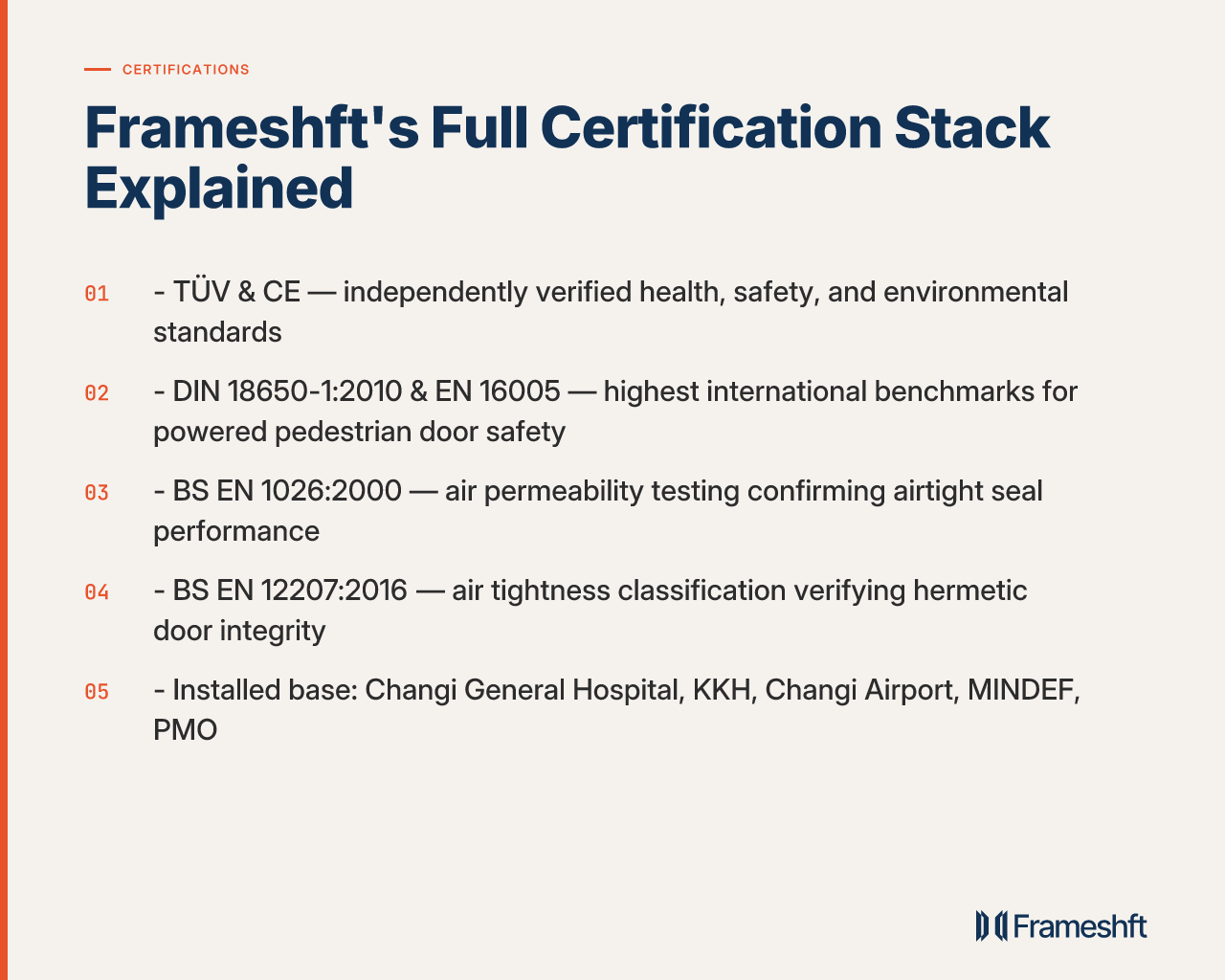
Frameshft's full certification stack — TÜV, COC, CE (LVD Directive), DIN18650-1:2010, EN16005, BS EN1026:2000, BS EN12207:2016 — is not a marketing asset. It is an evidence layer that tells a procurement team precisely what has been independently verified:
- TÜV & CE: The product meets European health, safety, and environmental protection standards. Not self-declared — independently verified.
- DIN 18650-1:2010 & EN 16005: The door system is engineered to the highest international safety standards for powered pedestrian doors, including sensor performance, impact prevention, and trapping prevention.
- BS EN 1026:2000 & BS EN 12207:2016: The hermetic door system has been tested and confirmed to perform its primary clinical function — maintaining an airtight seal. This is the certification pair that separates a genuinely hermetic door from one that is merely described as such in a brochure.
This certification stack is particularly significant in the Singapore context because very few automatic door contractors here can demonstrate BS EN1026 and BS EN12207 compliance for hermetic systems. When a procurement team shortlists suppliers, asking for these certificates immediately filters out suppliers whose hermetic offering is a commercial sliding door with a rubber gasket.
Frameshft's 14-year operating history — with an installed base that includes Changi General Hospital, KK Women's and Children's Hospital, and Changi Airport — provides the track record to support the certification stack. Equally important is the single-source accountability model: Frameshft designs, supplies, installs, and maintains under one roof. This eliminates the post-handover vendor fragmentation that creates accountability gaps when a door system underperforms — a scenario that is far more common in multi-contractor hospital projects than facility managers anticipate.
Your Ward-by-Ward Decision Guide Matrix
| Zone / Criteria | Automatic Sliding Door | Automatic Swing Door | Automatic Hermetic Door |
|---|---|---|---|
| General Ward Corridors | ✅ Excellent | ⭐ Acceptable | ❌ Over-specified |
| Nurse Stations | ✅ Excellent | ⚠️ Problematic swing arc | ❌ Over-specified |
| Isolation Rooms | ❌ No air seal | ❌ No air seal | ✅ Essential |
| ICU | ❌ No air seal, moderate noise | ❌ No air seal | ✅ Essential |
| OT Anteroom | ❌ No air seal | ❌ No air seal | ✅ Essential |
| Hygiene | ⭐ Good (touchless) | ⭐ Good (touchless) | ✅ Excellent (airtight seal) |
| Air Pressure | ❌ Poor | ❌ Poor | ✅ Excellent (certified) |
| Noise Control | ⚠️ Moderate | ⭐ Good | ✅ Excellent (STC35) |
| Wheelchair Clearance | ✅ Excellent | ⚠️ Moderate | ✅ Excellent |
| Fire Rating | Specify explicitly | Strong (standard) | Available on specification |
| Singapore Standards | BCA, EN16005, DIN18650 | BCA, EN16005, DIN18650 | BCA, EN16005, DIN18650, BS EN1026, BS EN12207 |
Making the Right Choice for Your Facility
The matrix above makes the core principle clear: door selection in a hospital is a zone-specific, performance-driven engineering decision. A sliding door that performs excellently in a general ward corridor is the wrong specification for an isolation room. A hermetic door that is essential for an OT anteroom is over-engineered and over-budget for a nurse station entrance.
The procurement trap is not selecting the wrong door type. It is applying a single door type across a facility without mapping each zone's clinical requirements — and only discovering the mismatch during an infection control audit, a BCA inspection, or worse, a clinical incident.
The right approach is a ward-by-ward engineering assessment that maps door type, sensor specification, certification requirements, and maintenance obligations to each zone before specification is locked.

Frequently Asked Questions
What is the most important factor when choosing an automatic door for a hospital?
The most important factor is the specific clinical requirement of the zone where the door will be installed. A one-size-fits-all approach is a significant risk. Doors in general corridors prioritize high traffic flow and wheelchair access (like automatic sliding doors), while doors for ICUs or operating theatres must provide an airtight seal to control air pressure and prevent contamination, which requires a certified hermetic door.
Why can't I just use a standard automatic sliding door for an isolation room?
You cannot use a standard automatic sliding door for an isolation room because it does not create an airtight seal. Isolation rooms rely on controlled air pressure to contain airborne pathogens or protect vulnerable patients. Standard sliding doors have gaps that allow air to leak, compromising the room's integrity and failing infection control protocols. Only a certified hermetic door can maintain the necessary seal.
What is a hermetic door and when is it essential?
A hermetic door is a specialized automatic door engineered to create a complete airtight seal when closed. Unlike standard doors, it uses a mechanism that presses the door against the frame and floor to prevent air leakage. This makes it essential for operating theatres, ICUs, and isolation rooms where controlling air pressure, sterility, and sound is a clinical necessity. Look for certifications like BS EN1026 and BS EN12207 to verify true hermetic performance.
How do Singapore's BCA standards affect automatic door selection?
Singapore's BCA (Building and Construction Authority) standards primarily govern accessibility, ensuring doors are safe and usable for everyone, including those with mobility impairments. This means automatic doors must meet specific requirements for clear opening widths, touchless activation sensors, and safety features. Choosing a system designed to meet BCA codes prevents costly failures during audits.
What is the difference between EN 16005 and DIN 18650 certifications?
Both are European safety standards for powered doors, but the German DIN 18650 standard is generally more stringent and detailed than the baseline EN 16005 standard. A door system certified to both standards demonstrates compliance with the highest international benchmarks for operational safety, sensor performance, and engineering quality, offering a higher level of assurance.
Why are supplier certifications so important for hospital procurement?
Supplier certifications are objective, third-party proof that a product meets specific safety, quality, and performance standards, which directly reduces risk for the hospital. For critical applications like hermetic doors, certifications like BS EN1026 (Air Permeability) and BS EN12207 (Air Tightness) are non-negotiable. They provide verifiable evidence that the door performs its clinical function, protecting the facility from both operational failures and legal liability.
Don't leave clinical safety and operational compliance to assumption.
Frameshft's engineering team conducts complimentary, no-obligation ward-by-ward assessments for Singapore hospital procurement teams — mapping the right automatic door for hospital ward Singapore environments against your specific zone requirements, compliance obligations, and long-term maintenance needs.
Request your ward-by-ward engineering assessment from Frameshft →
Tags
No tags
Published on June 01, 2026