
Hermetic Door vs Standard Automatic Door for Hospitals (What Actually Differs)
Hermetic door vs standard automatic door for hospitals — compare air permeability class, BS EN12207 certification, STC ratings, and failsafe locking for ICU and OR compliance.
You've probably heard it at a procurement meeting or from a contractor pitching a budget-friendly option: "We can just add a better gasket to the standard sliding door and it'll work fine for the ICU." It sounds reasonable.
But for a hospital facility manager specifying an airtight door for a hospital ward, operating theatre, or isolation room, that shortcut carries serious consequences. A hermetic door isn't a standard automatic door with upgraded weatherstripping — it's an entirely different class of engineered system, built from the ground up for sterile, pressure-controlled environments.
The distinction matters because infection control in a hospital isn't just about cleaning protocols; it's about environmental containment. ICU nurses will tell you they need to see their patients constantly, even when the door is closed for quiet, and that visibility requirement is why sliding glass doors dominate modern critical care design.
But the door also has to hold negative pressure, block airborne pathogens, and lock down when the power fails. A standard automatic door can't do any of that reliably, regardless of what gasket you attach to it.
A Side-by-Side Comparison: 6 Critical Differences
When you're specifying doors for operating theatres, isolation wards, or ICUs, the gap between a general-purpose sliding door and a medical-grade hermetic system becomes impossible to ignore.
1. Air Permeability Class: Sealing Against Invisible Threats
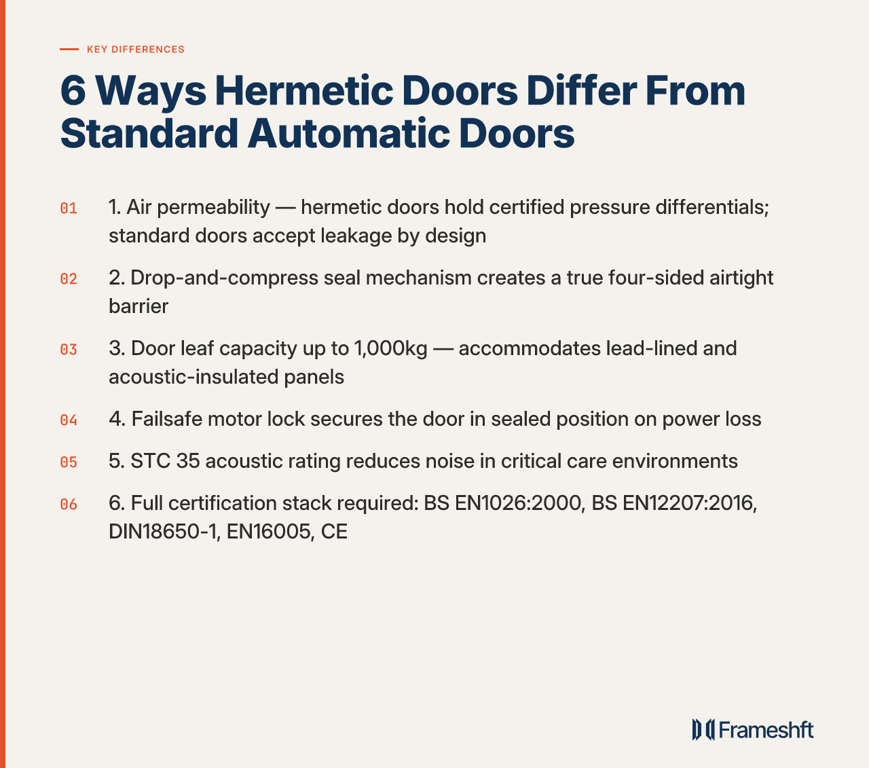
Air permeability is the single most important differentiator between a hermetic and a standard automatic door. Hermetic doors are engineered to maintain a measurable air pressure differential across the door leaf — which is exactly what negative pressure isolation rooms require to prevent airborne pathogens from escaping into a corridor. Certified air permeability ratings are the measurable proof that a door can contain airborne contaminants.
Standard automatic doors, the kind you'd find at a mall or clinic reception, accept air leakage as a design reality. They're built for convenience, not containment.
Adding a foam or rubber seal around the frame doesn't change the underlying air permeability class of the system. Frameshft's Automatic Hermetic Door is tested and certified to BS EN1026:2000 (method standard for air permeability testing) and achieves the highest classifications under BS EN12207:2016 — certification a standard automatic door simply doesn't carry.
2. Seal Compression Mechanism: How an Airtight Closure Actually Works
This is the engineering detail that most contractors gloss over. Specifically, a true hermetic door uses a drop-and-compress mechanism: as the door reaches the closed position, the leaf simultaneously drops downward and presses inward, compressing a continuous perimeter gasket against the frame on all four sides, including the floor. This mechanical compression is what creates a genuine hermetic seal capable of withstanding air pressure differentials.
Standard automatic doors use brush seals or light-contact weatherstripping along the base and sides. Those seals reduce dust ingress and minor drafts. They can't create or hold a pressurized barrier. The physics simply don't work — a brush seal pressed lightly against a threshold will deflect under even modest pressure differential, which defeats the entire purpose in a negative pressure room.
3. Door Leaf Weight Capacity: Built for Medical-Grade Materials
Hospital doors often carry far more than glass. Operating theatre doors may be lined with lead for radiation shielding. ICU doors can incorporate thick acoustic cores to reduce the noise that disrupts patient recovery. These materials add significant mass that a standard automatic operator isn't built to handle.
Frameshft's hermetic door system supports door leaves up to 1,000kg, which accommodates even the most demanding shielded or insulated panels. By comparison, Frameshft's standard automatic sliding door is rated at 200–360kg — more than adequate for commercial glass panels, but nowhere near enough for a lead-lined operating theatre door.
Hanging a 600kg medical-grade leaf on a commercial-grade operator doesn't just void the warranty; it creates a mechanical failure waiting to happen in an environment where downtime isn't acceptable.
4. Failsafe Locking on Power Loss: Containment Can't Be Conditional
In an ICU or isolation ward, a power outage doesn't suspend infection control requirements. The door still needs to hold. Standard automatic doors typically default to a free-sliding or manually-pushable state on power loss — a significant contamination and security risk in any clinical zone.
Hermetic doors are designed with failsafe motor locking as a core feature, not an add-on. Frameshft's system uses a 40V 100W German Dunkenmotoren drive unit with an integrated motor lock that automatically secures the door in the closed, sealed position the moment power is lost. This failsafe behaviour is one of the defining characteristics that separates a medical-grade entrance from a commercial one.
The door stays shut and sealed until power is restored and an authorized user grants access — no compromise, no manual override risk.
5. Sound Attenuation (STC): Acoustic Performance That Supports Recovery
Nurses on Reddit ICU discussions make the same point repeatedly: patients need the door closed for quiet to sleep, but staff still need visual access to monitor vitals. Heavy sedation aside, noise is a real clinical issue. In fact, disruptive sound in critical care environments can impair patient recovery and increase stress for both patients and staff.
A hermetic door's heavy leaf mass and compressed perimeter seal work together to produce meaningful acoustic attenuation as a byproduct of the airtight construction. Frameshft's hermetic doors achieve an STC 35 rating, which translates to substantial noise reduction across the door threshold. A standard automatic door — thin glass leaf, light-contact seals, un-gasketed frame gaps — offers no meaningful STC performance. Acoustic performance isn't even a design consideration in commercial automatic door specifications.
6. Certification Requirements: The Only Proof That Actually Holds Up
Certification validates—or invalidates—every other difference on this list. For example, a contractor can claim a door is airtight, but without third-party certification, that claim carries no weight in a hospital accreditation audit or a regulatory inspection.
A properly specified hermetic door for a hospital environment requires a full certification stack:
- DIN18650-1:2010 and EN16005 for automatic door safety (pedestrian impact and force limits)
- BS EN1026:2000 for air permeability test methodology
- BS EN12207:2016 for air permeability performance classification
- CE marking under the Low Voltage Directive
Standard automatic doors will typically hold DIN18650-1 and EN16005 for basic safety compliance — but they won't carry BS EN1026 or BS EN12207, because those standards are irrelevant to their intended use. For hospital sterile zones, those air permeability certifications aren't optional. Frameshft holds this complete certification stack and is one of very few Singapore-based contractors who can. That's relevant not just for procurement — it's what your infection control team and accreditation body will ask for.

For general hospital access areas like lobbies and corridors, an accessibility-enhanced entrance is the right specification. But for sterile clinical zones, only a fully certified hermetic system meets the bar.
Is the Cost Difference Between These Two Doors Actually Significant?
Not when you account for what's at risk. The hermetic door vs standard automatic door cost gap at the procurement stage is real but modest relative to total hospital construction or renovation budgets. What isn't modest is the downstream cost of getting it wrong.
A failed infection control inspection can trigger mandatory remediation, project delays, and reputational damage that extends far beyond a single ward.
Furthermore, a regulatory non-compliance finding — particularly one tied to hospital-acquired infections, a risk highlighted by organisations like the Healthcare Infection Society — carries consequences that dwarf any upfront cost savings. Specifying the wrong door type in a sterile zone is precisely the kind of oversight that creates post-handover liability for facility managers and procurement teams.
Choosing a certified hermetic door is a risk management decision, not just a technical specification call. The door you install in an operating theatre or isolation ward needs to perform on day one and keep performing for years — which means it also needs to be maintained by someone who understands the system.
Frameshft covers the full project lifecycle for hospital entrance solutions, from engineering consultation and design through to installation and long-term preventive maintenance. With installations at Changi General Hospital and KK Women's and Children's Hospital, and a complete certification stack, the company provides single-source accountability that eliminates the vendor fragmentation that typically plagues multi-contractor hospital projects.
If your facility has aging hermetic systems that no longer meet current standards, Frameshft's retrofit and modernisation service can restore compliance without full structural reconstruction.

Ready to Specify the Right Door for Your Facility?
Start with the certification checklist. If a supplier can't produce BS EN1026:2000 and BS EN12207:2016 documentation for their hermetic system, the door isn't certified for hospital sterile zone use — regardless of what the product brochure says.
Review Frameshft's Automatic Hermetic Door specifications against your project requirements, and contact our team to discuss the right configuration for your operating theatre, ICU, or isolation ward.
Frequently Asked Questions About Hermetic Doors
Here are answers to common questions facility managers have about specifying these systems.
What is the main difference between a hermetic and a standard automatic door?
The primary difference is air permeability. It is engineered to create an airtight seal capable of maintaining air pressure differentials, which is essential for infection control in sterile environments. A standard automatic door is designed for convenience and allows for significant air leakage.
Can you make a standard sliding door hermetic by adding better seals?
No, you cannot. A true airtight seal is achieved through a specific mechanical design where the door leaf drops and compresses against the frame on all four sides. Simply adding gaskets or weatherstripping to a standard door does not replicate this mechanism and will not create a certified airtight barrier capable of holding pressure.
Why are these doors essential for hospital ICUs and operating theatres?
These specialized doors are essential in these areas for environmental containment. They prevent airborne pathogens from moving between controlled zones and public corridors by maintaining negative or positive air pressure. This is a critical component of a hospital's infection control strategy, protecting both patients and staff.
What specific certifications prove a door is truly hermetic?
To verify a door's performance, you must look for certifications for air permeability testing and classification. The key standards are BS EN1026:2000 (the test method) and BS EN12207:2016 (the performance classification). Without these, a door cannot be considered certified for sterile environments.
How does a hermetic door seal itself?
It uses a unique drop-and-compress mechanism. As it slides to the closed position, it also moves downward and inward, pressing a continuous gasket firmly against the door frame and floor. This mechanical compression creates a complete, unbroken seal around the entire perimeter.
What happens if a hermetic door loses power?
A medical-grade door of this type is designed with a failsafe locking system. During a power outage, it automatically locks in the closed and sealed position to keep containment from being compromised. This is a critical safety feature that standard automatic doors, which often default to a free-sliding state, do not have.
Do these doors also help with soundproofing?
Yes, they do. The combination of a heavy door leaf (often with an acoustic core) and the compressed perimeter seal provides significant sound attenuation. For example, Frameshft's doors achieve an STC 35 rating, which helps reduce noise in critical care environments and supports patient recovery.
Tags
No tags
Published on May 28, 2026