
5 DIN 18650 Door Operators Compared for Singapore Projects
Compare 5 DIN 18650 door operators for Singapore projects — GEZE, dormakaba, ASSA ABLOY, dormakaba ES Series, and Frameshft — across local parts availability, after-sales support, TÜV/COC/CE certification, and maintenance flexibility.
Summary
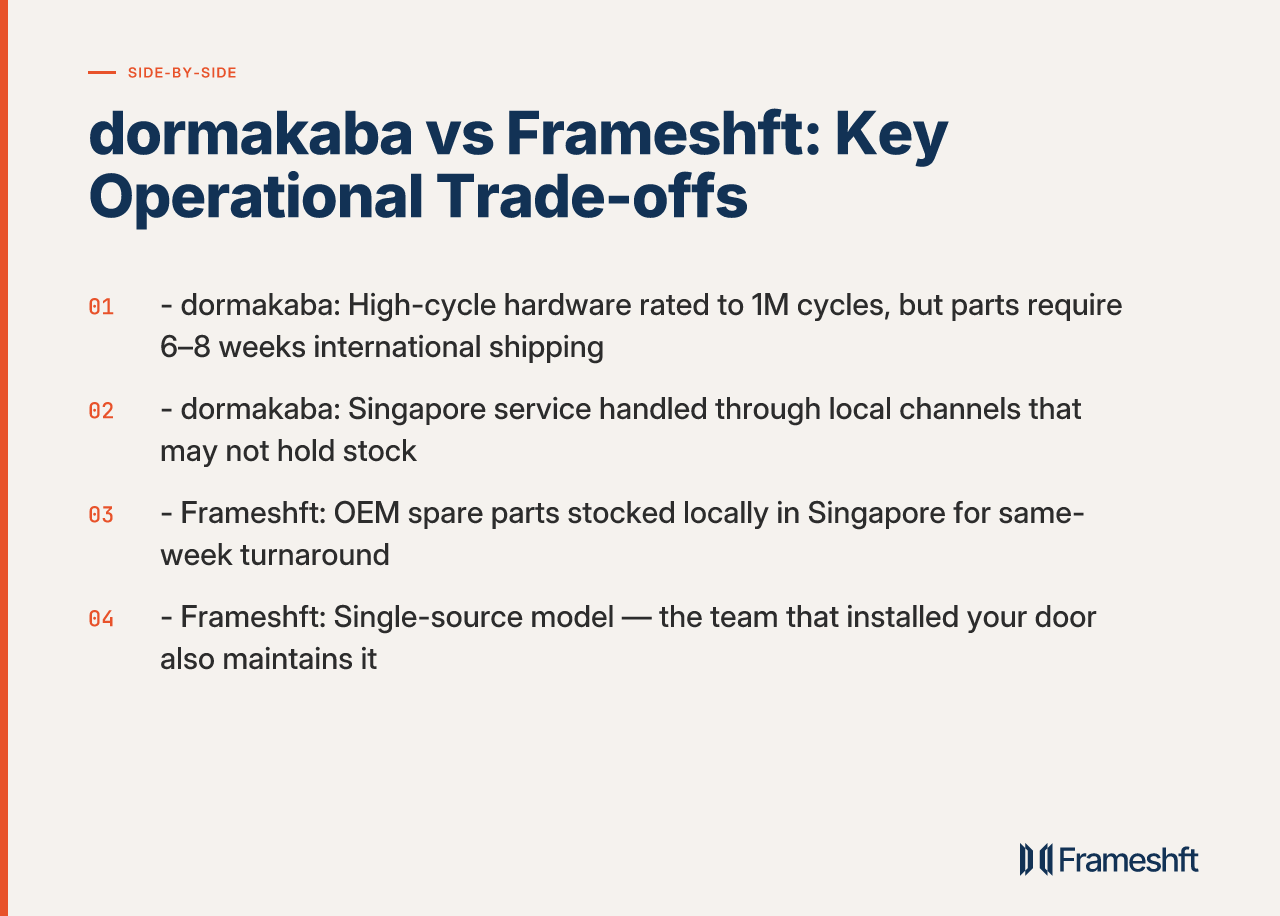
- Prolonged automatic door downtime in Singapore is often caused by fragmented service and long international lead times for spare parts (6–8 weeks), not poor hardware quality.
- The key difference between operators like Frameshft and major European brands (GEZE, dormakaba, ASSA ABLOY) is local parts availability and a single point of accountability for service.
- Facility managers can reduce operational risk by choosing a partner that handles the entire project lifecycle—from design and installation to long-term maintenance—under one roof.
- Frameshft offers a single-source solution with locally-stocked parts and flexible multi-brand maintenance contracts to solve these common challenges.
You've just received the handover keys for a newly installed automatic door system. Six months later, the operator fails during peak hours. You call the installing contractor — they say it's a parts issue. You call the parts supplier — they say delivery is 6–8 weeks from Germany. Meanwhile, your hospital lobby, retail entrance, or office atrium is stuck with a door propped open and a frustrated facilities team.
This is not a hypothetical. It is a pattern that repeats itself across Singapore's commercial and institutional buildings every year — and it stems less from product quality than from the fragmented way automatic door systems are specified, installed, and maintained locally.
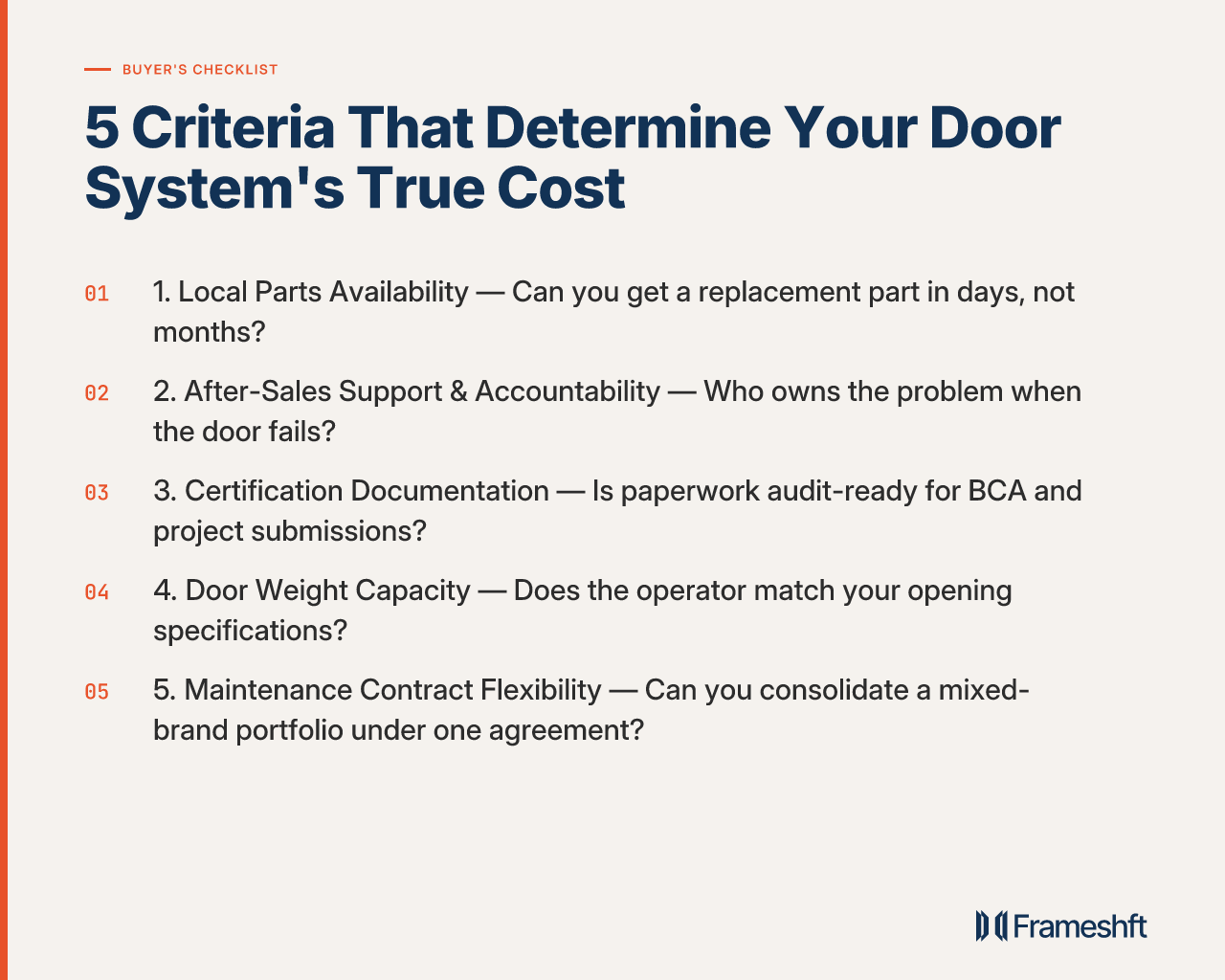
If you're a facility manager (FM) evaluating DIN 18650 door operators for a Singapore project, this guide is for you. We've benchmarked five of the most commonly specified brands — Frameshft, GEZE, dormakaba, dormakaba ES Series, and ASSA ABLOY — across the five criteria that actually determine your total cost of ownership and operational risk after handover:
- Local Parts Availability — Can you get a replacement part in days, not months?
- After-Sales Support & Accountability — Who is accountable when it breaks?
- Certification Documentation Completeness — Is the paperwork audit-ready? (TÜV, COC, CE, DIN 18650-1:2010, EN 16005)
- Door Weight Capacity — Does it fit your opening specs?
- Maintenance Contract Flexibility — Can you negotiate a contract that fits your portfolio?
One consistent theme from Singapore FM communities: the pain isn't usually the door hardware itself — it's the fragmentation between installer, supplier, and maintenance contractor that causes downstream problems. This comparison is designed to close that gap.
1. Frameshft — The Local Benchmark for Single-Source Accountability
Frameshft is a Singapore-founded entrance solutions specialist (est. 2012) that covers the entire project lifecycle under one roof: engineering consultation, system design, supply, installation, and long-term preventive maintenance. Their operators use German Dunkenmotoren drive units, and critically, OEM spare parts are stocked locally in Singapore — meaning no international lead times when something fails.
Local Parts Availability: High. This is the clearest operational differentiator. When a Frameshft-installed door fails, parts are sourced domestically. For FMs managing SLAs in hospitals, airports, or government buildings, this alone is a decisive factor.
After-Sales Support: Excellent. Frameshft's single-source model means the team that designed and installed your door is also the team maintaining it. There is no handover gap, no finger-pointing between a separate installer and a separate service contractor. Their preventive maintenance packages also cover competitor brands — meaning FMs with mixed-brand portfolios can consolidate into a single contract.
Certification: Full Stack. TÜV, COC, CE (LVD Directive), DIN 18650-1:2010, EN 16005, BS EN1026:2000, BS EN12207:2016. Documentation is complete and submission-ready for local project approvals and BCA audits.
Door Weight Capacity: 200kg–1,000kg. Their standard automatic sliding door handles 200–360kg at up to 1,400mm/sec. The hermetic door and heavy-duty sliding door are rated to 1,000kg — covering operating theatres, ICUs, cold storage, and industrial environments.
Maintenance Contract Flexibility: Flexible. Contracts are structured to cover mixed installed bases. Whether you have legacy GEZE, dormakaba, or ASSA ABLOY units on site, Frameshft can consolidate them under a single service agreement.
Installed base includes: Changi General Hospital, KK Women's and Children's Hospital, Changi Airport, MINDEF, Prime Minister's Office, Barclays, Visa, and Apple.
2. GEZE — The Established European Innovator
GEZE has been engineering entrance systems since 1863. Their product quality is well-regarded, and their sliding door range offers solid compliance with EN 16005 and broader European standards. For projects where building automation integration is a priority, GEZE's ecosystem has genuine depth.
Local Parts Availability: Moderate. GEZE has a regional presence in Asia, but specific critical components — particularly for older or specialised models — may still require international shipping. In practice, this can translate to multi-week lead times for less common parts.
After-Sales Support: Strong, but fragmented. In Singapore, GEZE systems are typically installed and maintained through authorised local partners. This introduces the classic split-vendor problem: the installer and the maintenance provider are often separate entities, and post-handover accountability can diffuse quickly.
Certification: Strong. Compliant with TÜV and key European standards including EN 16005. COC documentation is generally available but may require additional coordination for local project submissions.
Door Weight Capacity: Up to ~250kg for standard sliding operators.
Maintenance Contract Flexibility: Variable. Depends heavily on the local authorised partner rather than GEZE's global policy.
FM Pain Point: The gap between GEZE's European engineering reputation and on-the-ground service delivery in Singapore. When something goes wrong, the accountability chain — manufacturer → regional distributor → local installer → maintenance contractor — is long.

3. dormakaba — The High-Traffic Workhorse
dormakaba is a global brand with genuine engineering credentials for high-traffic environments. Their swing door operators are tested to one million cycles under severe weather conditions, and their self-learning microprocessors adjust swing speed dynamically for smooth, consistent operation. For heavily trafficked retail or transit environments, this is a real strength.
Local Parts Availability: Low. This is dormakaba's most significant operational weakness in Singapore. Replacement parts for their operators are not consistently stocked locally, and international procurement through their supply chain can run to several weeks. For FMs with uptime obligations, this is a critical risk.
After-Sales Support: Moderate. Global infrastructure exists, but Singapore-level execution is handled through local channels that may or may not carry stock, and may not be the original installing contractor.
Certification: Adheres to TÜV certification standards.
Door Weight Capacity: Up to ~200kg for many standard models in the Singapore market.
Maintenance Contract Flexibility: Limited. Contracts tend to be structured around brand-specific service terms, making consolidation with mixed portfolios more difficult.
FM Pain Point: High-quality hardware with a support structure that struggles to match the pace of operational demands in Singapore. The long parts lead time is the dominant complaint.
Tired of 8-Week Delays? Frameshft ends the waiting game with Singapore-stocked OEM parts for fast, reliable automatic door repairs. [Book a Free Site Survey]
4. dormakaba ES Series (ES 400) — The Healthcare Contender
The dormakaba ES 400 series is purpose-engineered for demanding institutional environments — hospitals, laboratories, and clinics. Its integrated airlock function supports up to three coordinated door sets, a meaningful feature for sterile zone management in healthcare facilities. The compact ES 410 (single-panel) handles up to 200kg; the ES 420 (double-panel) handles 2 × 125kg. Both are compliant with DIN 18650 and EN 16005 — making the ES series one of the more specification-complete European options for Singapore healthcare procurement.
Local Parts Availability: Low. Despite its healthcare positioning, the ES series suffers from the same supply chain limitations as the broader dormakaba brand. For hospital FMs managing operating theatre or ICU door uptime, the prospect of a multi-week parts wait is operationally unacceptable.
After-Sales Support: Moderate. Competent at brand level; execution in Singapore depends on the appointed local service contractor.
Certification: CE and TÜV compliant. DIN 18650 and EN 16005 documented in the technical brochure — useful for local project submissions when the documentation is requested at tender.
Door Weight Capacity: ES 410: 200kg / ES 420: 2 × 125kg.
Maintenance Contract Flexibility: Standard. Terms are relatively conventional; limited room for portfolio-level customisation.
FM Pain Point: The ES series is well-engineered for healthcare — but the supply chain reality undermines its fitness for Singapore's critical infrastructure environments. A specialist hermetic door operator supported by local parts stockholding, like Frameshft's hermetic door, removes this risk at the source.
5. ASSA ABLOY — The Global Access Giant
ASSA ABLOY is the world's largest lock and door hardware company, and their automatic door range reflects this scale. The SW60 swing door operator stands out for its low-profile design — useful for retrofitting into spaces with constrained overhead clearance — and their sliding operators reach up to 350kg door weight capacity, competitive against most of the market.
Local Parts Availability: Low. Like other multinational brands, ASSA ABLOY's local parts stockholding in Singapore can be inconsistent. Specific components, particularly for specialised or less common models, rely on international logistics.
After-Sales Support: Moderate. Their authorised service network in Singapore covers basic maintenance needs, but the same post-handover vendor fragmentation issue applies: installation and maintenance are often handled by separate local contractors.
Certification: Compliant with ANSI A156.19 and major international standards. COC documentation is available, though alignment with Singapore-specific submission requirements should be confirmed at project specification stage.
Door Weight Capacity: Up to ~350kg for sliding operators — one of the higher ratings among the brands assessed here.
Maintenance Contract Flexibility: Rigid. This is a documented pain point for FMs managing large or diverse door portfolios. ASSA ABLOY's contract structures tend to be non-negotiable, making portfolio-level consolidation difficult.
FM Pain Point: Strong hardware specs but inflexible post-sales service terms. For FMs who need to manage a mixed-brand installed base under a single consolidated contract, ASSA ABLOY's rigidity works against them.

At-A-Glance: DIN 18650 Door Operator Comparison Table
| Brand | Local Parts Availability | After-Sales Support | Certification Completeness | Door Weight Capacity | Maintenance Contract Flexibility |
|---|---|---|---|---|---|
| Frameshft | High | Excellent (single-source) | TÜV, COC, CE, DIN 18650-1, EN 16005, BS EN1026, BS EN12207 | 200–1,000kg | Flexible (multi-brand coverage) |
| GEZE | Moderate | Strong (but split-vendor) | TÜV, EN 16005 | Up to ~250kg | Variable |
| dormakaba | Low | Moderate | TÜV | Up to ~200kg | Limited |
| dormakaba ES Series | Low | Moderate | CE, TÜV, DIN 18650, EN 16005 | Up to 200kg | Standard |
| ASSA ABLOY | Low | Moderate | COC, ANSI A156.19 | Up to ~350kg | Rigid |
Beyond the Spec Sheet: Why Single-Source Accountability Wins in Singapore
Every brand in this comparison produces legitimate, DIN 18650-compliant hardware. The European brands especially — GEZE, dormakaba, and ASSA ABLOY — have engineering pedigrees that are difficult to fault at the product level.
But Singapore FMs consistently find that hardware quality is not where projects go wrong. The failure mode is split-vendor post-handover fragmentation — the point at which the consultant, the supplier, the installer, and the maintenance contractor are four different parties with four different interests. When the door fails at 8am on a Monday, nobody owns the problem end-to-end.
The pattern is consistent: fragmentation between contractor, supplier, and maintenance provider creates accountability gaps that no amount of good hardware can compensate for — not because FMs are uninformed, but because the handover documentation, accountability chain, and service continuity were never structured to hold together.
The strategic answer for Singapore projects is a partner who designs, supplies, installs, and maintains under a single contract and a single point of accountability. For DIN 18650 door Singapore projects specifically — where compliance documentation, local parts availability, and service response time all have direct operational consequences — the lifecycle architecture matters as much as the operator specification.
Frameshft's model is built around exactly this reality: a Singapore-based team, locally held OEM parts, a full certification stack ready for submission, and maintenance contracts flexible enough to cover your entire door portfolio — including legacy systems from other brands via their multi-brand repair and servicing.
One Contractor. Full Accountability. Frameshft designs, supplies, installs, and maintains your entrance systems under one roof for zero post-handover headaches. [Speak to an Expert]
Take Control of Your Compliance
Before your next automatic door project goes to tender — or before your next BCA audit — get a free on-site assessment from Frameshft's engineers to verify that your entrances are fully documented and specification-compliant.
📋 Book a Free Site Survey → A no-obligation site visit for facility managers to verify that their automatic door operators meet safety standards, certification requirements, and local project submission criteria.
Frequently Asked Questions
What is DIN 18650 and why is it important for automatic doors in Singapore?
DIN 18650 is a German industrial standard specifying safety requirements for power-operated pedestrian doors. This certification is important in Singapore as it verifies that the door system has passed rigorous tests for user safety, performance, and reliability, which is often a critical requirement for local project approvals and BCA audits in commercial and institutional buildings.
Why is local parts availability so critical for automatic door systems?
Local parts availability is critical because it directly determines the speed of repairs and minimises downtime. When an essential component fails, relying on international shipping can lead to delays of 6–8 weeks, leaving a key entrance unusable. For high-traffic facilities like hospitals, airports, or retail centres, such prolonged disruptions are a major operational risk. A provider with local stock can resolve issues in days, not months.
What does "single-source accountability" mean for facility managers?
Single-source accountability means one company manages the entire lifecycle of your automatic door system—from consultation and installation to long-term maintenance. This benefits facility managers by providing a single point of contact and eliminating the common issue of different vendors blaming each other when a problem arises. It ensures faster troubleshooting, clear responsibility, and more reliable service.
How do I choose the right automatic door operator for my building?
To choose the right automatic door operator, evaluate vendors on criteria that impact long-term operational costs and reliability. Key factors include: local availability of spare parts, a clear and accountable after-sales support structure, complete and audit-ready certification documents (e.g., DIN 18650, EN 16005), sufficient door weight capacity for your needs, and flexible maintenance contracts that can adapt to your portfolio.
Can I consolidate maintenance for different brands of automatic doors under one contract?
Yes, some specialised service providers allow you to consolidate maintenance for a mixed-brand door portfolio under a single contract. Companies like Frameshft offer multi-brand repair and servicing, which simplifies contract management for facility managers. This approach reduces administrative work and ensures consistent service standards across all entrances, regardless of who manufactured the operators.
What are the most common reasons for prolonged automatic door downtime?
While wear and tear on components like motors, sensors, and belts can cause failures, the most common reason for prolonged downtime is a fragmented support system. When the installer, parts supplier, and maintenance contractor are separate companies, it often leads to slow response times, finger-pointing, and long delays in sourcing parts. This logistical challenge, rather than the initial hardware failure, is what keeps doors out of service for extended periods.
Managing a mixed-brand door portfolio or planning an upcoming entrance project? Book a free site survey with Frameshft — no obligation. With 14 years of Singapore-based experience across hospitals, airports, government buildings, and commercial facilities, Frameshft helps FMs consolidate fragmented door maintenance programmes and build entrance infrastructure that holds up — not just at handover, but for the full lifecycle of the building.
Tags
No tags
Published on June 01, 2026