
7 Best Hermetic Door Suppliers for Cleanrooms in Singapore
Best hermetic door suppliers for cleanrooms in Singapore — evaluated on BS EN1026, BS EN12207, DIN18650-1 certification, local support, lead times, and after-sales servicing.
Summary
- The integrity of a cleanroom's environment often fails at the door, where poor seals compromise air pressure control and lead to compliance issues.
- When procuring a hermetic door, demand primary test certificates for air permeability (BS EN1026/12207) to verify performance, as many suppliers cannot provide them.
- Prioritise suppliers with single-source accountability and a local engineering team to avoid fragmented responsibility and long downtimes for critical repairs.
- For a fully certified solution backed by 14 years of Singapore-based engineering and maintenance, consider Frameshft's Automatic Hermetic Door.
Your cleanroom temperature has climbed past 22°C by noon. Employees are sweating. Cleaning chemicals aren't drying fast enough, creating slip hazards. You've had the AHU inspected twice — contractors find nothing out of specification, yet the problems persist.
You check the HEPA fan motors, recalibrate the discharge air temperature, re-examine the ACPH ratio — and still the cleanroom environment drifts. Here's something that often gets missed: a cleanroom's environmental integrity is only as strong as its weakest seal. And in many facilities, that weakest seal is the door.
For Singapore-based facilities managers and cleanroom consultants, the procurement challenge is compounded by a market saturated with generic suppliers who lack genuine local accountability. Too many vendors operate through distributors, ship parts from overseas, and leave you chasing multiple contractors post-handover when something goes wrong. Finding a hermetic door cleanroom Singapore partner — one with verified certifications, genuine local support, and a proven installed base — is harder than it should be.
This article cuts through the noise. Below are seven hermetic door suppliers and supplier categories serving Singapore's cleanroom market, evaluated on the criteria that matter most: certification stack, local support capability, lead times, and after-sales servicing.
Why Your Hermetic Door Choice is Mission-Critical
Before the list, a quick primer on what you're actually buying.
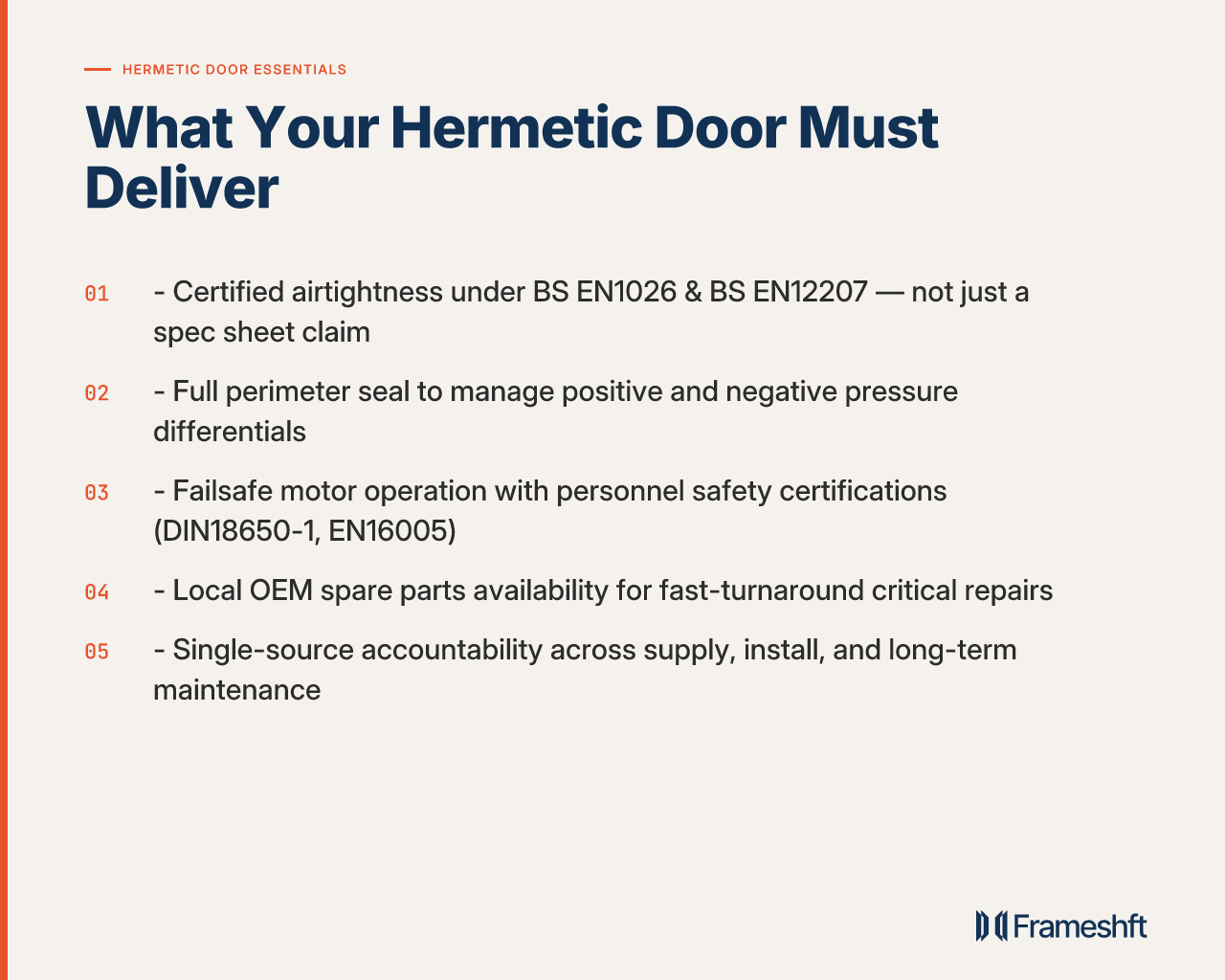
A hermetic door is an airtight automatic door engineered to maintain a peripheral seal when closed, making it essential for any environment where air pressure control, hygiene, and contamination prevention are non-negotiable. In cleanroom applications, hermetic doors manage the pressure differentials between zones — positive pressure in sterile areas, negative pressure in containment zones — preventing the ingress of airborne particles, bacteria, and humidity.
Key applications include:
- Medical: Operating theatres, ICUs, isolation rooms, X-ray suites
- Pharmaceutical & Life Sciences: Cleanroom production areas, BSL laboratories
- Semiconductor & Electronics: ISO-classified cleanroom bays and gowning areas
Without a certified hermetic door maintaining its seal integrity under real operating conditions, you're fighting a losing battle with your AHU, HEPA, and HVAC systems. All that engineered airflow management leaks out — or in — at the threshold.
The 7 Best Hermetic Door Suppliers for Cleanrooms in Singapore
Evaluated on: certification stack, local support capability, lead times, and after-sales servicing.
1. Frameshft Pte. Ltd. — Best Overall for Full-Certification Local Accountability
Profile: Singapore-incorporated entrance solutions specialist, founded in 2012 by Darren Loh Wei Jian (B.Eng. Mechanical Engineering, NUS). 14 years of operating history with a verified installed base in healthcare, government, and commercial facilities across Singapore.
Why it leads the list: Frameshft is one of very few Singapore-based contractors holding the full hermetic door certification stack — and they design, supply, install, and maintain under one roof. That single-source accountability eliminates the post-handover fragmentation that leaves facility managers chasing three different vendors when a seal fails at 2am.
Certification Stack:
- BS EN1026:2000 & BS EN12207:2016 — European standards for air permeability testing. These are direct, verifiable measurements of how airtight the door actually is under pressure. Ask any supplier for these certificates; many cannot produce them.
- DIN18650-1:2010 & EN16005 — German and European safety standards for automatic door operators, governing personnel safety during operation.
- CE (LVD Directive) — Conformity with European health, safety, and environmental protection requirements.
- TÜV & COC — Independent third-party testing and certification.
Product: The Frameshft Automatic Hermetic Door is engineered specifically for pressure-differential sterile environments. Key specifications include:
- Failsafe motor locking with a 40V 100W German Dunkenmotoren drive unit
- Door leaves accommodating up to 1,000kg
- Sound insulation rated at STC35
- Flush anodised aluminium edging with sealed panel integration for full perimeter airtightness
Local Track Record: Installed base includes Changi General Hospital, KK Women's and Children's Hospital, Changi Airport, MINDEF, and the Prime Minister's Office — environments where door failure is not an acceptable outcome.
Lead Times & After-Sales: Frameshft holds OEM spare parts in Singapore for their own-brand operators, meaning no international shipping delays when a critical component needs replacing. They also offer preventive maintenance packages and multi-brand repair services, so you can consolidate your entire door portfolio under a single maintenance contract.
For cleanroom procurement managers who need to meet ISO 14644 compliance and clinical-grade sterility requirements, Frameshft's combination of certification depth and Singapore-based engineering makes it the frontrunner.
2. Dortek — Best for Hygienic GRP Door Panels
Profile: International specialist in high-performance, hygienic Glass Reinforced Polyester (GRP) doors, with a Singapore presence serving healthcare and life sciences sectors.
Certification: Strong credentials in cleanroom hygiene standards. Their panel construction is designed to resist bacterial harbourage.
Local Support: Dortek operates locally in Singapore and provides consultation and support on the ground, which is a meaningful advantage over pure import distributors.
Lead Times: As an international manufacturer, custom door configurations may carry longer lead times than locally produced alternatives. Worth clarifying at specification stage.
After-Sales: Local support capability exists, though the degree of in-house engineering depth for complex cleanroom pressure management should be verified during procurement.
Best for: Cleanrooms where GRP panel hygiene properties are the primary specification driver — pharmaceutical production, food-grade environments, or applications where chemical resistance is paramount.
3. Airtech Equipment Pte Ltd — Best for Cleanroom-Integrated Procurement
Profile: Singapore-based provider of cleanroom and laboratory equipment, offering hermetic doors as part of a broader cleanroom supply portfolio.
Certification: Their hermetic doors carry EN 1026 / EN 12207 Class 4 air permeability certification — a meaningful benchmark that confirms measurable airtightness under test conditions.
Product Range: Offers both swing and sliding hermetic door configurations, with finish options including phenolic resin and stainless steel (AISI 304/316). Specialised variants are available, including lead-lined doors for X-ray rooms.
Local Support: Established Singapore presence with cleanroom-specific expertise. As a cleanroom solutions provider rather than a pure door specialist, they understand the environmental context your door needs to perform within.
Lead Times & After-Sales: Likely to have reasonable local support infrastructure given their broader cleanroom project involvement.
Best for: Project procurement teams sourcing hermetic doors as part of a larger cleanroom fit-out, where consolidated supply from a single cleanroom specialist is efficient.

4. Cleanroom Specialists — Best for Turnkey Project Delivery
Profile: A company focused on end-to-end cleanroom construction and fit-out, from design validation through to installation and commissioning.
Certification: ISO-certified with expertise in cleanroom door requirements within the context of ISO 14644 overall compliance. Their value proposition centres on the integrated cleanroom environment, not the door in isolation.
Local Support: Provide local consultation, project management, and installation as part of their full turnkey scope.
Lead Times: Typically project-sequenced, with the door specified and delivered within a broader construction timeline.
After-Sales: Post-handover servicing for the specific door system should be individually verified — turnkey contractors vary in their long-term maintenance commitment once a project is completed.
Best for: New cleanroom construction projects where you want a single contractor managing the entire envelope, and the door specification can be integrated into the overall design process from the outset.
Who Owns the Door Post-Handover? Frameshft offers true single-source accountability, from certified installation to Singapore-based maintenance, so you're never left chasing vendors. [Book a Consultation]
5. International Brands with Local Distributors
Profile: Global door automation manufacturers operating in Singapore through distributor networks or local subsidiaries.
Certification: Products from major international brands typically carry extensive European and international certifications. However, it is important to confirm whether the specific hermetic door variant offered carries BS EN1026 and BS EN12207 air permeability test data — not just general CE marking.
Local Support: Variable, and this is the critical risk. Accountability can be diffused between the international manufacturer and the local distributor. When a seal fails or a motor needs replacing, knowing precisely who is responsible — and how fast they can respond — is essential in a cleanroom environment.
Lead Times: Custom configurations and spare parts often involve international supply chains, which can create extended lead times for critical repairs.
Best for: Facilities with an existing relationship with a specific international brand or those where specification alignment with a global framework is required. Scrutinise the local distributor's service capability carefully before committing.
6. Regional Suppliers with a Singapore Presence
Profile: Door manufacturers based in APAC markets — Malaysia, South Korea, China — with sales offices or project representation in Singapore.
Certification: A mixed picture. Some regional manufacturers have invested in European certification; others carry only regional or self-declared standards. Always request primary test certificates, not just specification sheets.
Local Support: Technical expertise for complex issues may need to be sourced from regional headquarters, adding response time in emergency situations.
Lead Times: Faster than European or North American suppliers, but still reliant on overseas manufacturing and potentially regional parts inventories.
Best for: Budget-conscious projects where speed of delivery and price point take priority over the deepest certification stack. Appropriate due diligence on post-installation support is essential.
7. General Building Contractors with Cleanroom Divisions
Profile: Large construction firms offering cleanroom construction as part of a broader M&E or fit-out scope.
Approach: These contractors typically source and integrate hermetic doors from third-party suppliers rather than supplying or manufacturing them directly. The door specification is part of the overall contract.
Accountability: Post-handover, the cleanroom contractor's primary relationship with you ends. Servicing, recertification, and maintenance of the hermetic door system are often outsourced or require you to re-engage the original door manufacturer directly — recreating the very vendor fragmentation you were trying to avoid.
Best for: New build projects where simplicity of contracting during construction is the priority. Ensure that clear post-handover maintenance arrangements are written into the contract before signing.
Tired of Vendor Blame-Shifting? Consolidate your door maintenance with Frameshft. We stock OEM parts in Singapore for fast repairs and offer single-source accountability. [Get a Quote]
Your Hermetic Door Supplier Shortlisting Checklist
Use this checklist when evaluating any hermetic door cleanroom Singapore vendor before committing to a specification or purchase order.
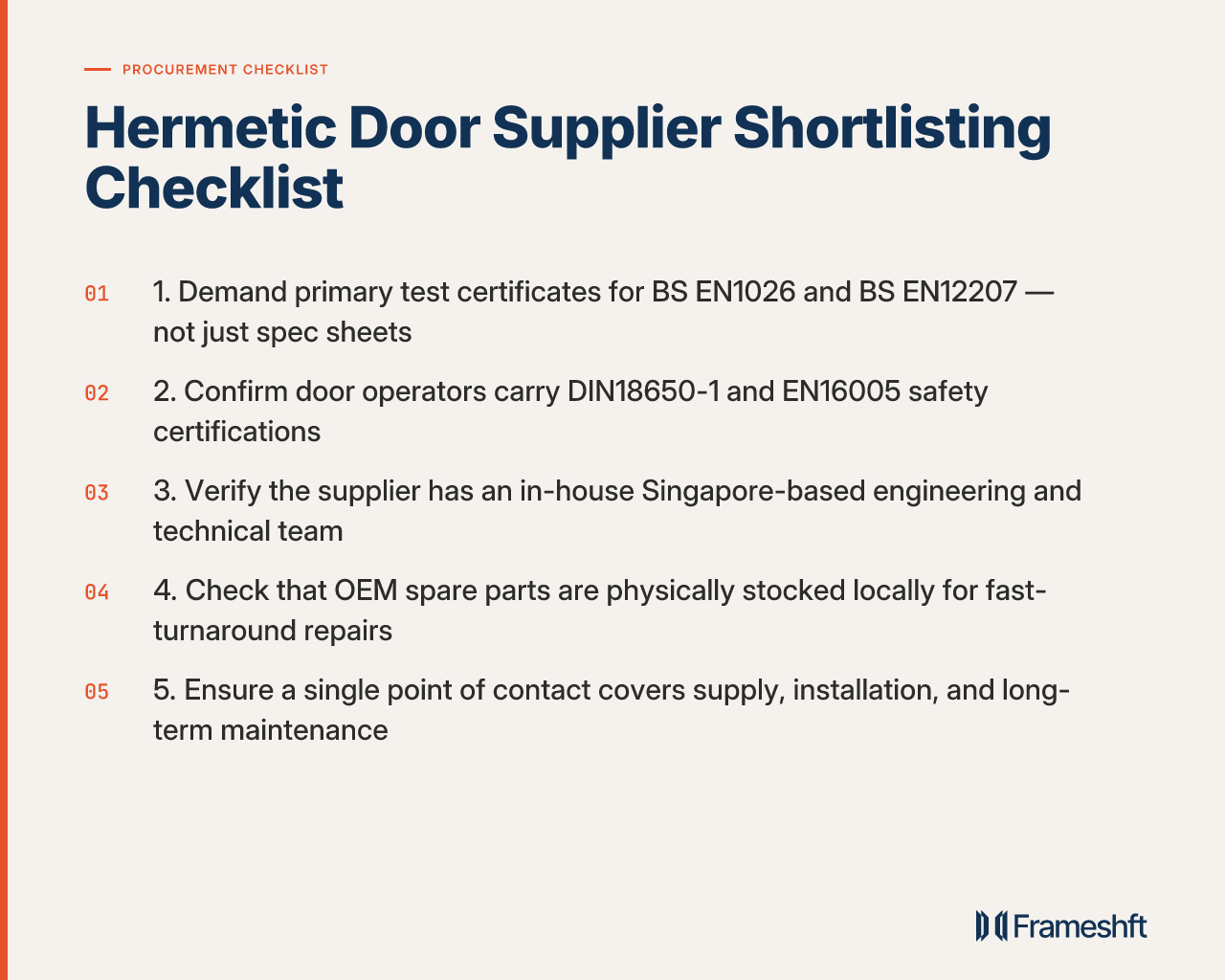
1. Certification — The Proof of Performance
- Can the supplier provide primary test certificates to BS EN1026:2000 and/or BS EN12207:2016? (Not just a spec sheet — ask for the actual test report.)
- Are the door operators certified under DIN18650-1 and EN16005 for operational personnel safety?
- Does the system carry CE marking under the LVD Directive?
2. Local Engineering & Support — The Lifeline
- Is there an in-house, Singapore-based engineering and technical team?
- Will installation be performed by the supplier's own engineers, or subcontracted?
- What is the guaranteed response time for a critical door failure in a sterile environment?
3. Proven Track Record — The Confidence Builder
- Can the supplier provide references for similar high-stakes environments in Singapore (hospitals, pharmaceutical cleanrooms, BSL laboratories, semiconductor fabs)?
- How long have they been operating in Singapore, and under what entity?
4. Supply Chain & Lead Times — The Project Reality
- Where are the door panels and key drive components manufactured?
- Are critical OEM spare parts physically stocked in Singapore?
- What is the lead time for a like-for-like replacement in the event of catastrophic failure?
5. After-Sales Accountability — The Long-Term Partnership
- Is there a single point of contact for all service, maintenance, and repair?
- Do they offer a structured preventive maintenance contract to preserve seal integrity and certification compliance over time?
- Can they service competitor-brand doors if you have a mixed installed base?
Make the Right Call for Your Cleanroom
Selecting a hermetic door supplier is not a commodity procurement decision. The door is the interface between your controlled environment and everything outside it. When air pressure differentials drift, when seal integrity degrades, when a motor fails mid-shift — the consequences for cleanroom compliance, product sterility, and patient safety are real and immediate.
The checklist above will surface the gaps quickly. Most suppliers will struggle at the certification and local accountability questions. The ones who can answer every item with documentation and references are the ones worth shortlisting.
Frameshft holds the full certification stack — BS EN1026:2000, BS EN12207:2016, DIN18650-1, EN16005, CE — alongside 14 years of Singapore-based operations and a proven installed base in facilities where performance is non-negotiable.

Frequently Asked Questions
What is a hermetic door and why is it essential for a cleanroom?
A hermetic door is a specialised, airtight automatic door designed to maintain a perfect seal when closed, which is essential for controlling air pressure, hygiene, and contamination in cleanrooms. Unlike standard doors, hermetic doors are engineered to manage the precise pressure differentials between different zones. This prevents airborne particles, bacteria, and humidity from entering sterile areas (positive pressure) or escaping containment zones (negative pressure), which is critical for meeting standards like ISO 14644.
What are the most important certifications for hermetic doors in Singapore?
The most critical certifications are BS EN1026:2000 and BS EN12207:2016, which verify the door's air permeability (airtightness) under pressure. These European standards provide measurable proof of a door's sealing performance. Additionally, look for safety certifications like DIN18650-1 and EN16005 for the automatic operator and CE marking for general compliance. Always ask suppliers for the actual test certificates, not just a mention on a spec sheet.
Why is local support so important when choosing a hermetic door supplier?
Local support is crucial because a failing hermetic door can immediately compromise your entire cleanroom environment, halting operations and violating compliance. A supplier with a Singapore-based engineering team and locally stocked spare parts can provide rapid response for critical failures. Relying on international suppliers with local distributors can lead to diffused accountability and long delays for parts, putting your facility at risk.
How does a hermetic door differ from a standard automatic sliding door?
The key difference is the sealing mechanism; a hermetic door is designed to be airtight, while a standard automatic door is not. A hermetic door features a specialised track system that causes the door panel to drop and press against the frame and floor as it closes, creating a full perimeter seal. Standard automatic doors have gaps around the edges, making them unsuitable for environments that require strict air pressure control.
How do hermetic doors contribute to ISO 14644 cleanroom compliance?
Hermetic doors are a fundamental component in achieving ISO 14644 compliance by preventing the ingress of airborne particulate contamination. The ISO 14644 standard classifies cleanrooms based on the concentration of airborne particles. A certified airtight hermetic door is essential for maintaining the required air cleanliness levels, managing pressure differentials between zones, and ensuring the HVAC and HEPA filtration systems can operate effectively. Without a proper seal, contaminants can easily bypass these systems.
What is the typical maintenance schedule for a cleanroom hermetic door?
Most manufacturers recommend a preventive maintenance inspection at least once or twice per year to ensure optimal performance and seal integrity. Regular maintenance is vital for a hermetic door. A qualified technician should inspect the seal for wear and tear, check the motor and drive components, test safety sensors, and verify that the door is closing and sealing correctly. A structured maintenance plan helps prevent unexpected failures and ensures long-term compliance.
Ready to specify with confidence? Contact Frameshft for a no-obligation consultation with an entrance solutions engineer and get a hermetic door solution engineered for your cleanroom's specific pressure, hygiene, and compliance requirements.
Tags
No tags
Published on June 01, 2026