
Automatic Door Singapore Buyer's Guide: Sliding vs Swing vs Hermetic
Automatic door Singapore buyer's guide: compare sliding, swing, telescopic, and hermetic door types by zone, compliance standard (EN16005, DIN18650, BCA), and total cost of ownership.
Summary
- Matching the correct automatic door type to the building zone is critical; for example, operating theatres require specialist hermetic doors, not standard sliding doors, to meet compliance.
- Key compliance standards for Singapore automatic doors include EN16005 for safety and the more stringent DIN18650, often specified for healthcare and government facilities.
- The most common cause of extended door downtime is a lack of locally-held spare parts, making it a critical question to ask any potential supplier.
- To avoid fragmented accountability and long repair delays, consider a single-source specialist like Frameshft that manages the entire project lifecycle with locally-stocked parts.
You have a budget, a timeline, and a BCA compliance requirement sitting on your desk. Three vendors have just quoted three different door types for the same opening. One says sliding. One says swing. One is quoting you a hermetic system you're not sure you need. And all three are telling you they're right.
This is the moment most facility managers in Singapore find themselves in — not during the comfortable planning phase, but right before a capital commitment. And it's also the moment where the wrong call gets made. The FM who specified a standard automatic door in Singapore across every zone in the building only to discover six months later that the operating theatre required a hermetic-certified system. The one who took the lowest quote, then waited three weeks for a replacement part shipped from Germany while the entrance sat broken.
This guide covers the five automatic door types used in commercial and institutional buildings across Singapore, how to match each type to the right zone, what the compliance standards actually require, and what to ask any contractor before signing. By the end, you'll know exactly what spec to walk into that vendor meeting with.
The 5 Automatic Door Types Used in Singapore Buildings
Most automatic entrance systems in Singapore fall into one of five categories. Each is engineered for a specific environment. Using the wrong type in the wrong zone is where the real costs appear — not at purchase, but at audit or breakdown.
Automatic Sliding Door
The most common commercial automatic door in Singapore. A standard bi-parting or single-leaf configuration that handles high foot traffic efficiently without requiring floor space on either side of the opening.
Key specifications to know:
- Door weight capacity: 200–360kg
- Travel speed: Up to 1,400mm/sec
- Drive unit: German Dunkenmotoren
- Processor: Self-learning with auto error detection
- Endurance: Cyclic tested to 2,000,000 cycles
- Compliance: DIN18650-1:2010 and EN16005 certified
Best for: Retail storefronts, commercial office lobbies, hospital corridors.
Full specifications at Frameshft's automatic sliding door page.
Automatic Swing Door
A hands-free single or double-leaf door activated by a touchless sensor. The swing door is the go-to specification for accessible routes because BCA compliance can be engineered in from the design stage — not bolted on after an audit finding.
Key features:
- Touchless activation for hygienic, contact-free use
- Single or double leaf configurations
- BCA accessibility compatible from the outset
Best for: Retail entrances, office corridors, handicap toilet systems, and designated BCA-compliant accessible entrance routes.
See full details on the automatic swing door page.
Automatic Telescopic Sliding Door
A multi-panel system where door leaves stack behind one another on the same track. This geometry creates a wider clear opening than a standard bi-parting door can achieve in the same structural header width — which matters when you're dealing with bed-transfer corridors or wide mall entrances where wall space is limited.
Key features:
- Multi-panel design for constrained header space
- Wide-span clear opening capability
- No additional side-room required beyond the panel stack depth
Best for: Hospital corridors requiring wide bed clearance, mall entrances, industrial zones with wide-span requirements.
More detail at the telescopic sliding door page.
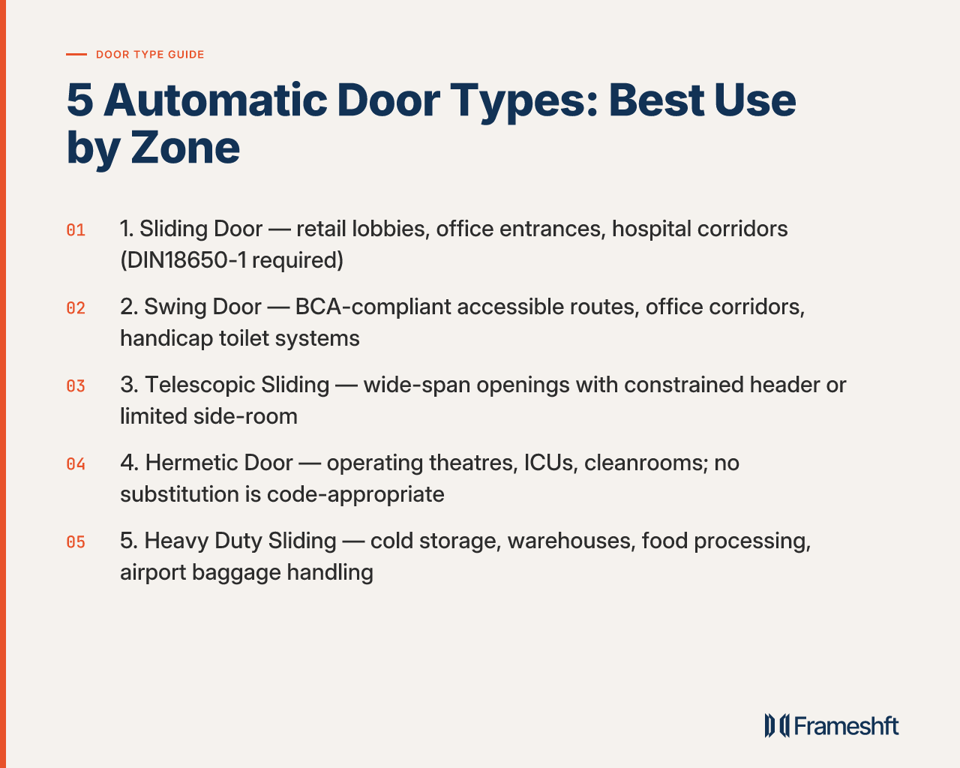
Hermetic Automatic Door
A specialist airtight sliding door engineered for sterile environments. On closing, the door panel drops and seals against the frame — maintaining air pressure differentials and preventing cross-contamination between zones. This is not a specification upgrade from a standard sliding door. It is a fundamentally different system.
Key specifications:
- Airtight seal designed to support positive and negative air pressure differentials
- Door leaf capacity: Up to 1,000kg
- Sound insulation: STC35
- Locking: Failsafe motor lock
- Drive unit: 40V 100W German Dunkenmotoren with integrated motor lock
- Compliance: BS EN1026:2000, BS EN12207:2016, DIN18650-1, EN16005, CE certified
Best for: Operating theatres, ICUs, cleanrooms, isolation rooms. No other door type is appropriate for these zones.
Full certification stack available at the hermetic door page.
Heavy Duty Automatic Sliding Door
An industrial-grade sliding door rated for environments that would destroy a standard commercial system within months. High-cycle counts, heavy door panels, and temperature-extreme conditions are the design brief here.
Key specifications:
- Door weight capacity: Up to 1,000kg
- Cycle rating: High-cycle industrial engineering
- Environment: Cold storage compatible, forklift clearance dimensions available
Best for: Warehouses, cold storage facilities, food processing plants, airport baggage handling areas.
Full details at the heavy duty automatic door page.
How to Match Door Type to Building Zone
If you're specifying or reviewing a specification for a building with multiple zones, use this as a quick-reference:
- Retail lobby / Commercial entrance → Sliding or Swing
- Hospital ward corridor → Sliding (DIN18650-1:2010 compliant specification required)
- Operating theatre / ICU → Hermetic only — no substitution is code-appropriate
- Wide-span entrance with limited header or side-room → Telescopic sliding
- Cold storage / Warehouse / Manufacturing plant → Heavy duty sliding
- BCA-compliant accessible entrance or handicap toilet → Swing or Sliding with touchless activation (accessibility entrance details)
If a vendor is quoting you a standard sliding door for an operating theatre, that is not a cost-saving option. It is a compliance failure waiting to happen.

What Singapore Compliance Standards Actually Mean for Your Door Selection
FMs are often handed a specification that lists compliance requirements without explanation. Here is what the key standards actually require.
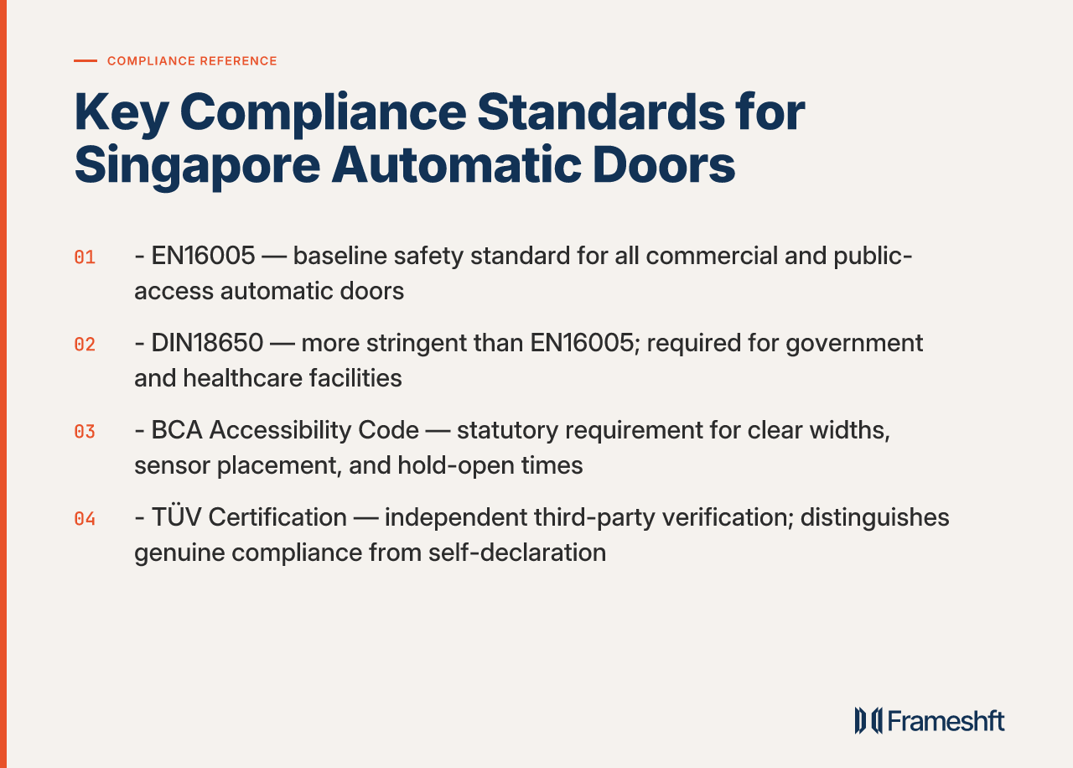
EN16005 The primary European safety standard for power-operated pedestrian doors, and the baseline benchmark in Singapore. It governs the safety sensor performance, activation zone geometry, finger-trap protection requirements, and maximum allowable force limits during door movement. Any automatic door installed in a commercial or public-access building should meet this standard as a minimum.
DIN18650 A German standard that goes further than EN16005 in several areas, particularly around durability benchmarks and safety margins. It is widely specified for Singapore government projects, healthcare facilities, and institutional buildings because its requirements are more demanding than the European baseline. If your building is tenanted by a government agency or classified as a healthcare facility, expect DIN18650 to be on the specification.
BCA Accessibility Code Singapore's local code governing accessible design. For automatic doors, it specifies minimum clear opening widths, activation sensor placement (including push-pad height for wheelchair users), and minimum hold-open duration to allow safe passage for mobility-impaired users. This is not optional for buildings with designated accessible routes — it is a statutory requirement.
TÜV Certification TÜV is an independent third-party testing body. When a door operator carries TÜV certification, it means an external auditor has verified the claimed compliance. Not all suppliers carry this. It is one of the cleaner ways to distinguish manufacturers who have genuinely tested their systems from those who self-declare compliance.
For a detailed breakdown of how these standards are applied in practice, refer to the automatic sliding door certifications section. A full EN16005 compliance guide is also being published.
Single-Source vs Multi-Vendor: The Hidden Cost Most FMs Discover Too Late
The most common automatic door Singapore procurement mistake isn't choosing the wrong door type. It's splitting the contractor relationships.
Here is what that looks like in practice. The main contractor installs the door. Maintenance is contracted separately to a third party. Six months later, a drive unit fails. The maintenance contractor tells you the part is not in stock locally — it needs to be ordered from the European manufacturer. Estimated lead time: three weeks. The door is on a high-footfall entrance to a hospital ward. You now have three weeks of a broken door, a workaround that creates an accessibility gap, and two contractors pointing at each other over who bears the cost.
This scenario is not hypothetical. It is the most common post-handover complaint from facility managers managing mixed-brand or multi-contractor door portfolios.
The structural problem is accountability fragmentation. When the designer, installer, and maintenance provider are three separate entities, there is no single party who is responsible for whole-system performance over the door's operational life.
Frameshft, a Singapore-based entrance solutions specialist with 14 years of operating history, was built specifically around this problem. The company handles the full project lifecycle — engineering consultation, system design, supply of its own-brand operators (using German Dunkenmotoren drive units), installation, and long-term preventive maintenance — under one roof. Critically, OEM spare parts are held in Singapore, which means the three-week-from-Germany scenario does not apply to their installed systems.
Their installed base includes Changi General Hospital, KK Women's and Children's Hospital, Changi Airport, MINDEF, and the Prime Minister's Office — environments where door downtime is not a recoverable situation.
This single-source accountability model also applies to maintenance across competitor brands. For facility managers managing a legacy portfolio of mixed-brand doors, Frameshft's preventive maintenance contract and multi-brand repair and servicing can consolidate multiple vendor relationships into one contract and one point of contact.

What to Ask Any Automatic Door Contractor in Singapore Before You Sign
Before committing to any automatic door installation Singapore contract, run through these six questions. The answers will tell you more about a contractor's operational model than their brochure will.
1. Do you hold OEM spare parts locally? If the answer is no — or vague — assume a 2–4 week lead time for any non-trivial repair. For high-traffic or critical-access doors, that is an unacceptable operational risk.
2. What certifications does your door operator carry? Ask specifically for EN16005, DIN18650, and any third-party verification such as TÜV. A contractor who cannot produce certification documentation is asking you to take their word for compliance.
3. Will you service competitor brands on the same contract? If you manage a building with multiple door brands already installed, consolidating maintenance under one contract reduces administrative overhead and eliminates the coordination cost of managing separate vendors. Not all contractors offer this — ask directly.
4. What is your emergency call-out SLA? For hospital entrances, data centre doors, or any critical-access zone, define the acceptable response time before you sign. Get it written into the contract.
5. Can you provide commissioning documentation for a BCA or MOH audit? Any reputable contractor should produce full commissioning records, compliance certificates, and test documentation at handover. If they hesitate on this, it is a signal about how they operate post-installation.
6. Who is accountable after project handover — the installer or a separate maintenance company? This is the single most important question. If the answer is "the maintenance will be handled by another party," ask who that party is and how accountability is structured between them. Then weigh whether a single-source contractor removes that risk entirely.
For a detailed supplier checklist, see that post when published. Our installation contractor ranked guide also covers how to evaluate contractors for complex projects.
Choosing the Right Automatic Door in Singapore Starts with the Right Spec
The opening scenario — budget locked, timeline set, three vendors quoting three different systems — is not a vendor problem. It's a specification problem. When the spec is clear before the RFQ goes out, vendor responses become comparable, and the right door type for each zone is not a matter of opinion.
Getting the spec right means matching the door type to the zone's actual requirements: traffic volume, accessibility obligations, sterility requirements, structural constraints, and the compliance standards that apply. A retail lobby and an operating theatre are not the same opening. They should never receive the same specification.
For automatic door Singapore procurement, the other variable that rarely appears on a specification sheet is the long-term service model. The total cost of ownership for an automatic door includes not just the hardware and installation, but the parts availability, the response time when something fails, and who picks up the phone at night when a critical entrance goes down.
A single accountable partner who engineers, installs, and maintains under one roof — with local parts stock and a full certification stack — is not a premium option. Over a five-year maintenance cycle, it is typically the lower-cost model once reactive call-outs and downtime costs are factored in.
For a technical assessment of your building's entrance requirements — including zone-by-zone specification recommendations — contact the engineering team at Frameshft. To compare providers before making a decision, the best automatic door companies in Singapore guide is a useful next step.
FAQs
What is the most common automatic door type used in Singapore commercial buildings?
The automatic sliding door is the most widely installed type across retail, office, and healthcare environments in Singapore. Its ability to handle high foot traffic without requiring floor clearance on either side makes it the default specification for most commercial lobby and corridor applications.
Does my automatic door need to be EN16005 compliant in Singapore?
Yes, EN16005 is the recognised safety standard for power-operated pedestrian doors and is the baseline requirement for commercial and public-access buildings. Compliance governs sensor performance, force limits, and finger-trap protection. For government and healthcare projects, the more demanding DIN18650 standard is often additionally specified.
What's the difference between a hermetic door and a standard automatic sliding door?
A standard automatic sliding door is designed for general access, while a hermetic door is a specialist system with an airtight seal. The hermetic seal is engineered to maintain air pressure and prevent contamination in sterile environments like operating theatres and cleanrooms. The two systems are not interchangeable.
What is the difference between a standard and a telescopic sliding door?
A telescopic sliding door creates a wider clear opening than a standard sliding door within the same header width. It uses multiple stacking panels on separate tracks, making it ideal for corridors with limited wall space where a wide opening is needed for things like hospital beds or high-volume pedestrian flow.
How do I ensure my automatic door is BCA compliant for accessibility?
To ensure BCA compliance, the door must meet specific criteria for clear opening width, activation sensor placement (e.g., push-pads at wheelchair height), and minimum hold-open times. The most effective way to guarantee compliance is to work with a specialist contractor who can engineer these requirements into the system from the design phase.
How often should automatic doors be serviced in Singapore?
Professional servicing should be conducted at least once a year as a minimum requirement under EN16005. However, for high-traffic environments like hospitals, malls, and transport hubs, bi-annual servicing is recommended to prevent breakdowns by identifying wear and tear early.
Why is holding local spare parts a critical factor for a supplier?
Holding local spare parts is critical because it minimises operational downtime. A supplier without local stock will have to order parts from overseas, which can lead to repair delays of several weeks. This poses a significant operational and safety risk for any critical entrance.
Can one contractor install and maintain automatic doors from different brands?
Yes, specialist firms with multi-brand service capability, such as Frameshft, can maintain and repair most major automatic door brands. This allows facility managers to consolidate a building's entire door portfolio under a single maintenance contract, simplifying administration and accountability.
Tags
No tags
Published on May 26, 2026